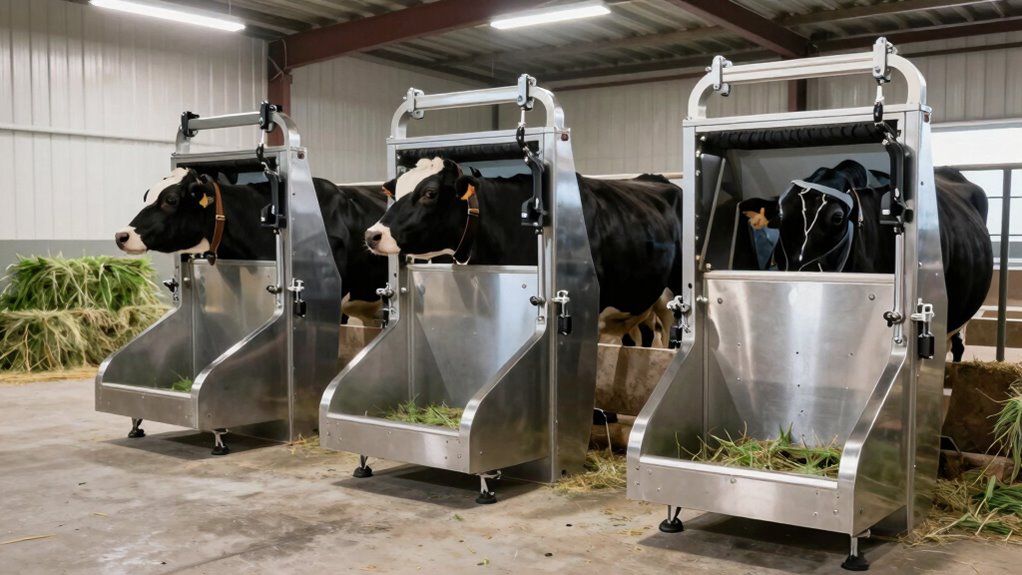

If you’re shopping for a cattle grooming chute in 2026, your real decision comes down to one question: are you working cattle at a fixed location on the farm, or hauling a fitting setup to shows every weekend? Those two use cases point to two very different products, and I’ve structured this guide around that split. For ranchers who need a permanent, heavy-duty handling solution that doubles as a grooming and processing station, the Tarter Cattlemaster Series 3 stands out for its rugged steel build and secure manual catch headgate. For show families who need to clip and fit calves at fairs and exhibitions, the Weaver Livestock Aluminum Folding Chute is the clear choice because it folds down to a compact rectangle and mounts to a trailer or gate in minutes. The tradeoff between them is straightforward: the Tarter buys you durability and animal control at the cost of a 985-pound unit you’ll never move alone, while the Weaver buys you portability at the cost of strength — it’s built for show-broke cattle, not wild range cows. Neither is a compromise version of the other; they’re purpose-built for different buyers, and I’ll help you figure out which one describes you.

Get furniture and decor delivered free with Prime
- Fast, free delivery on millions of items
- Prime Video, Amazon Music and more included
- Member-only deals all year
Complete the kit


Key Takeaways
- The Tarter Cattlemaster Series 3 is best for fixed-location ranch use where durability, animal control, and all-day processing outweigh portability.
- The Weaver Livestock Aluminum Chute is built exclusively for show-broke cattle at fairs and exhibitions, and it folds to a 66 x 34 inch rectangle for transport.
- Weight is the defining tradeoff: 985 lbs of steel versus a lightweight aluminum frame one person can carry.
- The Tarter’s manual catch headgate requires an operator at the chute, while the Weaver relies on a head lock suited to cooperative animals.
- Neither product replaces the other — buying the wrong one means either an immovable chute you can’t take to shows or a folding chute that flexes under unruly cattle.
| Tarter Cattlemaster Series 3 Cattle Chute with Manual Catch Headgate, Red |  | Best Overall for Ranch and Fixed-Location Grooming | Color: Red | Height: 79 in | Length: 96 in | VIEW ON AMAZON | See Our Full Breakdown |
| Weaver Livestock Aluminum Cattle Chute, Portable Folding Design |  | Best Portable Pick for Show Cattle and Fair-Season Fitting | Material: Aluminum | Folded Dimensions: 66″ x 34″ rectangle | Item Dimensions: Approx. 66.5″ x 37.5″ | VIEW ON AMAZON | See Our Full Breakdown |
| cattle grooming chute | Color | Height | Length | Width |
|---|---|---|---|---|
| Tarter Cattlemaster Series 3 C | Red | 79 in | 96 in | 61 in |
| Weaver Livestock Aluminum Catt | — | — | — | — |
More Details on Our Top Picks
Tarter Cattlemaster Series 3 Cattle Chute with Manual Catch Headgate, Red
The Tarter Cattlemaster Series 3 earns my top overall spot because it treats grooming not as a special occasion but as one part of everyday cattle work. With a 96-inch length, 61-inch width, and 79-inch height, the working envelope accommodates everything from grown cows to bulls, which matters if your grooming sessions run alongside vaccinating, deworming, or preg-checking — and on most operations, they do. The manual catch headgate is the heart of this chute: it gives the operator direct, positive control over when an animal’s head is caught and released, which is exactly what you want when the animal in front of you outweighs you by a factor of ten.
Compared with the Weaver Livestock Aluminum Chute, the difference is night and day in philosophy. The Weaver assumes the animal walks in calmly and stands while being clipped; the Tarter assumes nothing and physically contains whatever comes down the alley. That containment comes from heavy-gauge steel throughout, and the 985-pound weight is both the product’s greatest strength and its most meaningful drawback. You will need a tractor, skid steer, or at least two strong helpers and a trailer to position this chute, and once it’s set, it’s staying put. I also want to flag the tradeoff inherent to the manual headgate: it requires an operator at the chute at all times, so a solo producer working cattle will either need a self-catch alternative or a second set of hands. For buyers running a fixed working facility, though, these constraints read less like flaws and more like the cost of doing business with a tool built to outlast the truck that hauled it home.
Pros:- Heavy-duty steel construction built for years of daily ranch work
- Manual catch headgate provides positive, secure control over cattle of any temperament
- Large working dimensions handle everything from calves to mature bulls
- Red powder-coated finish stands up to outdoor weather and corralling wear
Cons:- At 985 lbs, moving or installing it requires machinery and at least two people
- Manual headgate demands a dedicated operator at the chute during every use
- Permanent-fixed design offers no practical portability for shows or satellite pastures
Best for: Ranchers and producers with a permanent working facility who need a durable grooming and processing chute for a range of cattle sizes and temperaments
Not ideal for: Show families who need to transport a chute to fairs, or solo operators who can’t commit to an operator-managed manual headgate
- Color:Red
- Height:79 in
- Length:96 in
- Width:61 in
- Weight:985 lbs
- Headgate Type:Manual Catch
- Construction:Heavy-duty steel
- Intended Use:Ranch processing and grooming at a fixed location
Our verdict“If you work cattle in one place and want a grooming chute that doubles as a bulletproof processing station, this is the one that makes the most sense.”
Weaver Livestock Aluminum Cattle Chute, Portable Folding Design
The Weaver Livestock Aluminum Chute wins the portability contest so decisively that it’s barely a contest. Folded into a 66 x 34 inch rectangle, this chute slides into a truck bed or tack compartment and carries comfortably thanks to its aluminum build — a single person can manage it, which is something the 985-pound Tarter can never claim. It mounts to a trailer or gate, converting any flat surface into a controlled clipping and fitting space in minutes. For show families whose season is measured in weekends at the fairgrounds, that setup speed is worth more than any amount of steel.
The design details show that Weaver understands the show barn specifically. The powder-coated side bars and head lock exist to prevent raw aluminum from transferring gray residue onto a fitted hair coat — a small thing that matters enormously on show day. The adjustable side pipe positioning lets you dial in the fit for a smaller calf or a broader yearling, something the fixed-dimension Tarter approach handles through sheer size rather than adjustability. But I have to be direct about the limitation: this chute is built for show-broke cattle. An animal that fights, rears, or slams the panels will flex and potentially bend the aluminum frame, and repairs on show day are not a scenario anyone wants. Compared with the Tarter’s containment-first philosophy, the Weaver is a cooperation-first tool. Within its lane — halter-trained calves at fairs, shows, and exhibitions — it’s the smarter buy; outside that lane, it’s the wrong tool, full stop.
Pros:- Folds to a compact 66 x 34 inch rectangle for easy truck-bed transport and off-season storage
- Lightweight aluminum construction allows one person to carry and mount it
- Powder-coated side bars and head lock prevent aluminum oxidation from marking fitted hair
- Smooth-sliding adjustable side posts create a customized fit for calves of different sizes
Cons:- Only suitable for show-broke, cooperative cattle — unruly animals can damage it
- Aluminum frame can bend and flex under stress and requires careful handling
- No standalone base; it must mount to a trailer or gate to function
Best for: Show cattle exhibitors and families who clip and fit halter-broke animals at fairs, jackpots, and exhibitions and need a chute they can haul and set up solo
Not ideal for: Anyone working unruly or range cattle, or producers who need a heavy-duty permanent handling system
- Material:Aluminum
- Folded Dimensions:66″ x 34″ rectangle
- Item Dimensions:Approx. 66.5″ x 37.5″
- Finish:Powder-coated side bars and head lock
- Mounting:Trailer or gate mount
- Adjustability:Adjustable side pipe positioning
- Intended Animals:Show-broke cattle
- Primary Use:Fitting and clipping at fairs and shows
Our verdict“For fair-season fitting of halter-broke calves, this folding aluminum chute is the most practical option on this list — just don’t ask it to be a ranch working chute.”

How We Picked
Since a cattle grooming chute has to serve two very different worlds — ranch processing and show fitting — I evaluated each option against the specific job it claims to do rather than judging them on a single shared scale. My first criterion was structural intent: whether the chute is engineered as permanent infrastructure or as a portable fitting station, because that single distinction determines almost everything else about the ownership experience. From there, I weighed animal control, meaning how securely the headgate or head lock restrains cattle of varying temperaments, and how much operator involvement that restraint demands. I also looked at materials and finish — steel versus aluminum, and coatings that either survive years of weather or protect groomed hair coat from oxidation transfer. Finally, I considered practical logistics: what it takes to move, install, and store each unit, since a chute that doesn’t fit your workflow simply won’t get used. Products that blurred these lines or claimed to do both jobs were excluded, because in my judgment a chute that tries to be both a ranch workhorse and a show-day tool tends to do neither well.
Factors to Consider When Choosing Cattle Grooming Chute
Before clicking buy on either chute, run your situation through these four questions — they’ll point you to the right product faster than any spec sheet.Fixed Facility or Show Circuit?
This is the single biggest deciding factor. If your cattle handling happens at one location — a barn, a set of working pens, a corral system — the Tarter Cattlemaster Series 3 fits naturally into that infrastructure. If your grooming happens wherever the next show is, the Weaver folding chute is the only option of the two that can realistically travel with you. Trying to force one into the other’s role leads to either a chute that never leaves the farm or one that gets destroyed by the wrong animal.
What Kind of Cattle Are You Handling?
Temperament matters more than most buyers expect. Show-broke, halter-trained animals stand quietly in a lightweight aluminum chute, which is exactly what the Weaver is engineered around. Unruly or range cattle need the steel containment and positive-locking headgate of the Tarter, because an aluminum frame will flex, bend, or fail under a fighting animal. Match the chute to your worst-behaved animal, not your best one.
Who’s Operating the Chute?
The Tarter’s manual catch headgate requires someone physically at the chute to catch and release each animal’s head — great for control, but it means solo producers need either a helper or a different headgate style. The Weaver’s head lock is simpler to manage but depends on the animal cooperating. If your crew is one person and a broke calf, the Weaver workflow is actually smoother; if you have a crew working a herd, the Tarter is built for that rhythm.
Transport, Storage, and Surface
The Tarter weighs 985 pounds, so plan for machinery to move and install it, and plan for it to stay where you put it. The Weaver folds flat and stores in a corner but has no freestanding base — it must attach to a trailer or gate, so confirm you’ll always have a suitable mounting surface at your destination. Neither detail shows up in a product photo, and both will define your day-to-day experience.
Frequently Asked Questions
Can the Weaver Livestock Aluminum Chute handle cattle that aren’t show-broke?
I wouldn’t recommend it. The Weaver is engineered around the assumption that the animal walks in calmly and stands while being clipped, and its aluminum construction is a deliberate weight-saving choice rather than a strength choice. An animal that rears, slams the panels, or fights the head lock can bend and flex the frame, and that damage is difficult to repair mid-show-weekend. If even a portion of your cattle are unruly or fresh off pasture, the Tarter Cattlemaster Series 3 with its steel build and manual catch headgate is the safer containment option. Reserving the Weaver for genuinely halter-broke show animals is the difference between a chute that lasts a decade and one that’s compromised in a single bad session.
How hard is it to move and install the Tarter Cattlemaster Series 3?
Plan on using equipment. At 985 pounds, this chute cannot be muscled into place by hand, so you’ll need a tractor, skid steer, front-end loader, or a coordinated crew with proper lifting gear. The upside of that weight is stability: once it’s set in your working facility, cattle can lean, push, and strain against it without shifting the chute or stressing the frame. My suggestion is to decide on a semi-permanent location before delivery day, ideally aligned with your existing alley and crowding tub, so you’re only positioning it once. Buyers who anticipate moving their working setup between pastures should think carefully, because that’s a logistical burden the Tarter wasn’t designed to absorb.
Does the Tarter’s manual headgate work for one person working alone?
It’s possible but demanding. A manual catch headgate requires the operator to be physically present to operate the catch and release, which means one person is simultaneously moving cattle down the alley, running the headgate, and performing the grooming or processing task. In practice, solo operators find this workable for a few head but exhausting for a full day of processing. If you routinely work alone with more than a handful of animals, a self-catching or automatic headgate design may suit your workflow better, or you can plan around having a helper on working days. For crews of two or more, the manual catch is arguably an advantage because it gives the operator precise, positive control over every catch.
Why does the powder-coated finish on the Weaver chute matter for show cattle?
Raw aluminum oxidizes, and that oxidation transfers as a gray residue onto anything it rubs against — including a carefully fitted and groomed hair coat. On a show calf whose appearance has been conditioned, trained, and clipped for weeks, gray smudges along the ribs or shoulder are a real competitive problem. Weaver powder-coats the side bars and head lock specifically so that the surfaces an animal contacts don’t mark the coat, which tells you how tightly this product is designed around show-day outcomes. It’s a small detail, but it’s the kind of detail that separates a chute built for the show barn from a general-purpose handling chute with a fresh coat of paint.
Which chute should I buy if I both work cattle at home and show a few calves?
If the budget allows only one, buy based on where the greater need sits — and for most operations in that situation, that means the Tarter. Herd-level health processing, grooming, and handling at home happen far more often than show weekends, and the Tarter covers all of it with far more durability and animal control. You can usually clip a broke show calf at home in a heavier chute without issue, whereas you cannot safely put an unruly animal in a folding aluminum one. That said, if showing is your primary activity and home processing is minimal or handled elsewhere, the Weaver is the more sensible purchase because you’ll actually use its portability rather than fight its limitations.
Conclusion
After comparing these two side by side, the right pick depends entirely on where your cattle work happens. Ranchers and producers with a fixed working facility should choose the Tarter Cattlemaster Series 3 — its steel construction, generous working dimensions, and manual catch headgate make it the best overall choice for grooming, processing, and containing cattle of any size or temperament, provided you have equipment to place it and a crew to run the headgate. Show families and junior exhibitors should choose the Weaver Livestock Aluminum Folding Chute, because its 66 x 34 inch folded footprint, one-person carry weight, and coat-friendly powder-coated finish are purpose-built for fairgrounds life with halter-broke calves. And if you sit in both camps, my advice is to let frequency decide: buy the Tarter if home handling dominates your calendar, and add the Weaver later if the show circuit becomes a serious part of your program. Either way, buying the chute matched to your actual cattle and your actual calendar beats buying the one that simply looks tougher on paper.
Fall Picks
fall essentials
As an affiliate, we earn on qualifying purchases.