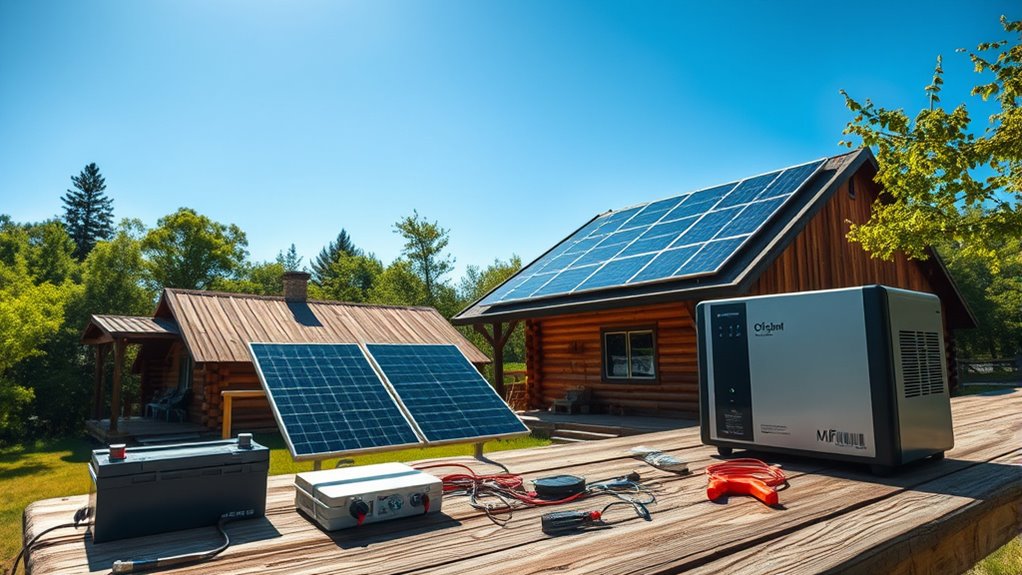

To establish off-grid solar for beginners, start by evaluating your energy needs and choosing the right system size. Select quality solar panels, batteries, and a charge controller, and position your panels in a sunny, unshaded spot facing the right direction for your hemisphere. Connect everything properly and regularly maintain batteries and panels to guarantee efficiency. With proper planning, you’ll create a reliable power system — keep exploring to learn all the essential steps involved.
Key Takeaways
- Assess your energy needs to determine the size of your off-grid solar system.
- Select appropriate solar panels, batteries, and charge controllers based on your power requirements.
- Properly orient and tilt panels for maximum sunlight exposure and efficiency.
- Install and connect components following manufacturer guidelines, ensuring secure wiring and safety.
- Regularly maintain batteries and clean panels to optimize system performance and longevity.
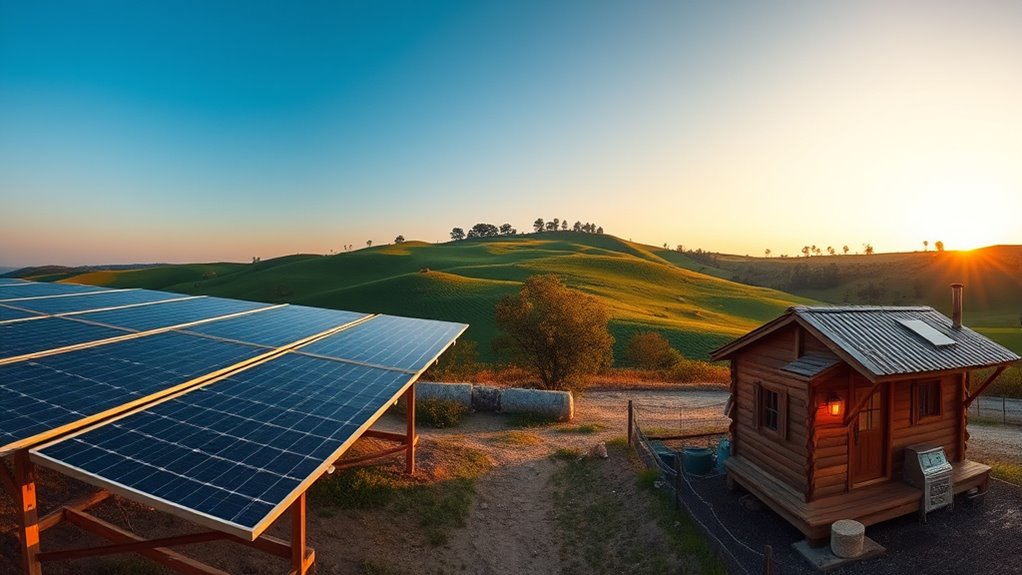
If you’re considering reliable power sources outside the grid, off-grid solar systems offer an excellent solution. They give you independence from traditional utilities, allowing you to generate your own clean energy. But to keep your system running smoothly, you need to understand some key basics. One of the most important aspects is proper battery maintenance. Your batteries store the energy produced by your solar panels, so keeping them in good condition is essential for reliable power. Regularly check the water levels in flooded lead-acid batteries, if you use them, and ensure terminals are clean and corrosion-free. For lithium-ion options, monitor voltage and state of charge to prevent over-discharging or over-charging, which can shorten battery lifespan. Always follow manufacturer guidelines for maintenance routines, and consider installing a battery monitor to keep an eye on performance. Proper care will ensure your batteries last longer and perform *crucially*, reducing the need for costly replacements.
Another *crucial* factor is solar panel orientation. The angle and direction of your panels directly affect how much sunlight they capture, which impacts your system’s efficiency. In the Northern Hemisphere, facing your panels toward true south maximizes exposure to sunlight throughout the day. Conversely, in the Southern Hemisphere, panels should face true north. The tilt angle should be adjusted based on your latitude; a good rule of thumb is to set the angle roughly equal to your location’s latitude for year-round performance. If you want to *optimize* for summer or winter, you can adjust the tilt accordingly—slightly steeper for winter to catch lower sun angles or flatter for summer. Make sure your panels are free of shading from trees, buildings, or other obstructions, as even small shadows can *significantly* decrease output. Regularly inspect the panels for dirt, dust, or debris, and clean them gently with a soft cloth and water to *ensure* peak efficiency. Proper solar panel orientation maximizes sunlight absorption, *significantly* ensuring your system produces enough power to meet your needs consistently.
Frequently Asked Questions
How Long Do Off-Grid Solar Batteries Typically Last?
Off-grid solar batteries typically last 5 to 15 years, depending on usage and maintenance. To maximize their lifespan, you should follow proper maintenance tips like keeping them charged, avoiding deep discharges, and maintaining a stable temperature. Regular inspections help identify issues early, ensuring your batteries stay efficient longer. Proper care can markedly extend your battery lifespan, making your off-grid solar system more reliable and cost-effective over time.
Can Off-Grid Solar Systems Power High-Energy Appliances?
Yes, off-grid solar systems can power high-energy appliances if you choose a solar panel with good durability and an inverter with sufficient capacity. Make certain your solar panels are durable enough to withstand weather conditions, and select an inverter that matches or exceeds the power needs of your appliances. Proper system design and component selection allow your off-grid setup to handle high-energy devices reliably.
What Is the Initial Cost of Setting up Off-Grid Solar?
The initial cost of setting up off-grid solar varies widely, but you should budget around $10,000 to $30,000 for a thorough system, including panels, batteries, and inverter. You can explore cost estimation tools online and consider financing options like loans or government incentives to make installation more affordable. Planning carefully helps you understand expenses upfront and ensures your system meets your energy needs effectively.
How Do I Maintain and Troubleshoot My System?
You might wonder how to keep your system running smoothly. Regularly perform system diagnostics to catch issues early, and watch for warning signs like dimming lights or unusual noises. When problems arise, you’ll need to substitute components such as batteries or inverters carefully. Staying proactive and knowledgeable about your system’s health guarantees it operates efficiently, preventing unexpected failures. With some attention, your off-grid solar setup will power your life reliably for years.
Are Off-Grid Solar Systems Scalable for Future Needs?
Yes, off-grid solar systems are scalable for future needs. You can start with a basic setup and add scalability options like extra batteries, panels, or inverters as your power demands grow. Planning for future expansion involves choosing flexible components and designing your system with capacity in mind. This way, you can easily upgrade your off-grid solar system, ensuring it meets your evolving energy requirements without needing a complete overhaul.
Conclusion
Starting off-grid solar might seem intimidating, but with clear steps, it’s totally doable. Don’t worry if you think it’s too expensive or complicated—initial investment pays off with reliable power and independence. Plus, as technology advances, systems become more affordable and user-friendly. Once you set it up, you’ll enjoy clean, renewable energy and never worry about outages again. Embrace the challenge—you’re making a smart, sustainable choice that benefits both you and the planet.