
TL;DR

Get furniture and decor delivered free with Prime
- Fast, free delivery on millions of items
- Prime Video, Amazon Music and more included
- Member-only deals all year
Haunted house wall art is decorative art depicting spooky houses — gothic mansions, Victorian homes, and abandoned dwellings — available in styles ranging from vintage 1920s Halloween prints to minimalist silhouettes. Etsy is the largest marketplace for independent artists in this niche, digital downloads let you print quality art at home for under $15, and dark academia trends have made spooky decor a year-round choice rather than an October-only tradition.
Last October, a friend of mine spent $180 on a single vintage Halloween die-cut from the 1930s — a crumbling cardboard haunted house with jack-o’-lantern eyes. Two months later, she found a high-quality reproduction of the exact same image on Etsy for $14. The collector in her winced. The decorator in her shrugged and bought three.
That’s the strange, wonderful state of haunted house wall art right now. What used to be a drugstore decoration you tossed on November 1st has become a genuine design category — spanning gothic oil paintings, retro horror prints, moody photography, and minimalist silhouettes that live on walls all year.
In this guide, you’ll learn the major styles, where to buy them, what they should cost, and how to display spooky art so it reads as intentional rather than leftover-from-a-Halloween-party.
Match the style to your room: minimalist silhouettes for modern homes, gothic Victorian for traditional or maximalist spaces.
Digital downloads ($3–15) printed on matte paper in a thrifted frame beat pre-printed art on price almost every time — roughly $34 total versus $45+ shipped.
Etsy is the largest marketplace for independent spooky artists; antique shops and estate sales are where original 1910s–1940s pieces surface, sometimes worth h…
Year-round display works when you commit to a moody palette (charcoal, deep green, oxblood) and mix spooky art with non-spooky pieces on one statement wall.
DIY routes — paint-by-numbers kits ($15–25), silhouette painting (~$12), upcycled estate-sale frames — produce genuinely displayable results with no artistic s…
What Exactly Counts as Haunted House Wall Art?
Haunted house wall art is any decorative art depicting haunted or spooky houses — gothic mansions, Victorian homes, abandoned farmhouses, crooked cottages with glowing windows. The category is broader than most people expect, and that breadth is exactly why it works in so many interiors.
Think of it like coffee. There’s the pumpkin-spice-latte version (cartoon ghosts, googly-eyed bats) and the single-origin-espresso version (a dark, Hopper-esque painting of an isolated house at dusk). Same bean, wildly different experience. The distinction matters because it determines where a piece belongs: the espresso version can hang in your living room in March, while the latte version reads as seasonal and belongs in storage by November. Misjudging this is the number one reason spooky art fails in a home — not the art itself, but the mismatch between tone and room.
The medium matters just as much as the image, because each one changes how the art is perceived:
- Canvas prints — textured, gallery-wrapped, no frame needed. Reads as modern and casual; hard to swap seasonally, so commit before buying.
- Framed prints — paper behind glass, easiest to swap seasonally. The frame does half the design work; this is the option for year-round displays.
- Metal signs — vintage tin-look, great for kitchens and game rooms. Durable and playful, but the retro finish leans novelty — best as an accent, not an anchor.
- Tapestries — large-format, softens a room, dorm-friendly. Covers a lot of wall cheaply, but reads casual rather than curated.
- Digital downloads — buy once, print at home or locally. Maximum flexibility, but the final quality depends entirely on your printing choices.
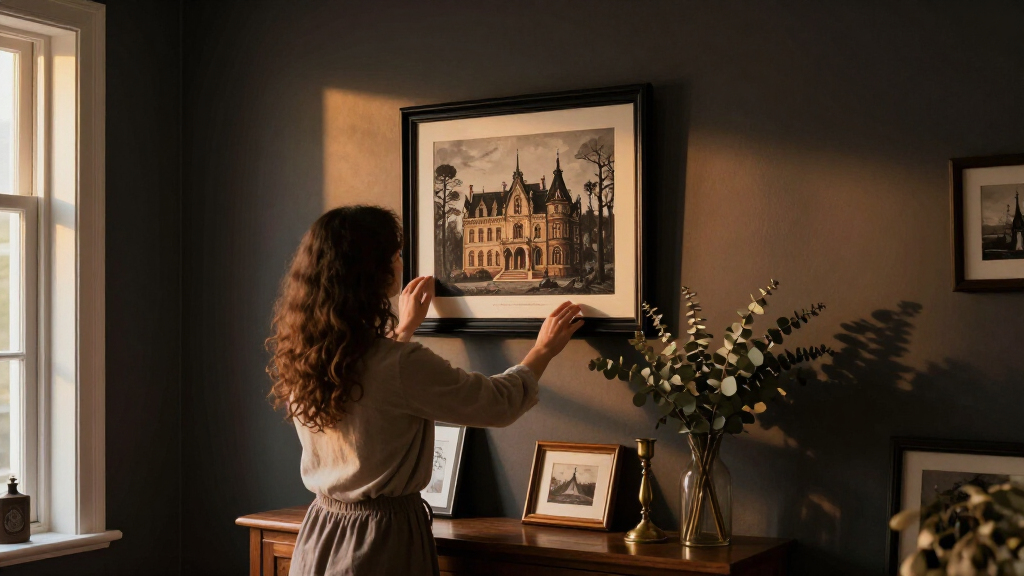
A single framed print of a lightning-lit Victorian manor can anchor an entire reading nook. That’s the power of this genre: unlike most decor, a haunted house image carries atmosphere all by itself — it implies a story, a storm, a history. One piece does the heavy lifting that would normally take five, which is why it rewards buying fewer, better pieces rather than scattering many small ones.
5 Styles That Define the Look (and Which One Fits Your Home)
Haunted house art splits into five distinct styles, and picking the right one is the difference between “moody and curated” and “party store clearance rack.” Here’s how they compare:
| Style | The Vibe | Best Room | Typical Price |
|---|---|---|---|
| Vintage/Retro Horror | 1920s–60s Halloween, classic monsters, Beistle reproductions | Entryway, powder room | $10–30 (repros) |
| Gothic Victorian | Dark mansions, candlelight, stormy skies | Study, bedroom, dining room | $25–100 |
| Spooky Cute/Kitsch | Cartoon ghosts, “spooky season” energy | Kids’ rooms, kitchens | $8–25 |
| Minimalist Silhouette | Single-color house outlines, stark and modern | Living room, office | $15–50 |
| Dark Fantasy Painting | Tim Burton meets oil paint, atmospheric | Statement wall, gallery | $40–200+ |
The famous inspirations behind these styles are instantly recognizable: The Addams Family mansion, the Psycho house, Disney’s Haunted Mansion (open since 1969 and still spawning licensed art), and Tim Burton’s crooked-steeple aesthetic. Edward Hopper’s lonely, light-stabbed houses deserve credit too — his paintings basically invented “isolation as decor.” These reference points matter because they let you diagnose what a piece is really doing: Addams Family energy is campy and maximalist, Hopper energy is quiet and melancholic. Same subject, opposite emotional register — and your room should agree with whichever one you pick.
The tradeoff at the heart of this decision is expressiveness versus longevity. Spooky-cute and retro styles are cheap, fun, and instantly legible, but they read as Halloween-specific and can tire quickly. Gothic Victorian and dark fantasy cost more and demand more from your room (moody paint, good lighting), but they hold up for years and appreciate as your decor evolves. Minimalist silhouettes are the compromise: modern enough for any interior, spooky enough to keep the theme — which is why they’ve become the default for people testing the waters.
If your home is modern and minimal, lean into silhouettes. If you lean maximalist, go full gothic Victorian and don’t apologize.
Where to Buy It: The Best Sources Ranked
Etsy is the single biggest marketplace for haunted house wall art, thanks to thousands of independent artists selling everything from digital downloads to hand-inked gothic illustrations. But it’s not your only option, and each source has tradeoffs — mainly a tradeoff between uniqueness, price, and speed.
- Etsy — best for unique, artist-made pieces and cheap digital downloads. Filter for reviews above 4.5 stars. The tradeoff: shipping times vary by artist, and print quality depends on who you buy from.
- Society6 & Redbubble — solid for trendy, pop-culture-adjacent spooky prints in many sizes. Less unique than Etsy, but consistent quality and fast fulfillment. Good middle ground.
- Displate — metal posters; scratch-proof, magnet-mounted, great for a modern industrial look. The premium buys durability: these survive moves, kids, and humidity that would warp canvas.
- Amazon & Wayfair — mass-market canvas prints, fastest shipping, least unique. Fine for filler pieces on a gallery wall; risky as a statement piece, since the same image ships to thousands of other homes.
- Antique shops & estate sales — the treasure hunt. Original 1910s–1940s die-cuts (Beistle, Dennison) can sell for hundreds of dollars, so inspect condition carefully. What you’re paying for isn’t the image — reproductions exist for $15 — it’s provenance and the authentic texture of aged ink and cardboard. Collectors pay for the object; decorators should usually pay for the image.
Quick tip: search Etsy for “vintage Halloween printable” and sort by bestseller. You’ll find reproductions of century-old Beistle designs for $3–8 — instant heirloom look for the price of a coffee.
For collectible originals, watch for reproduction vs. original labeling. A genuine 1930s die-cut has slightly faded inks and aged cardboard; modern reproductions are crisp. Both are lovely — just don’t pay collector prices for a reprint. This distinction is where the biggest money mistakes happen in this niche: the market is full of deliberately “aged-looking” reproductions, and the only reliable defense is checking the seller’s description for words like “reproduction,” “inspired by,” or “vintage-style” — all code for “not actually old.”
Are Digital Downloads Worth It? Here’s the Honest Math
Yes — digital download art is usually the cheapest way to get quality haunted house prints, typically costing $3–15 for a file you print yourself, versus $25–60 for the same image printed and shipped. You buy once and can print it in any size, forever. That “forever” is the underrated part: if a frame breaks, a print fades, or you move to a bigger place, you reprint at cost instead of rebuying.
Here’s a real scenario. You find a gothic mansion illustration on Etsy for $6. You upload the file to a print shop (or a pharmacy photo counter), order a 16×20 inch print on matte paper for about $8, and pop it into a $20 thrifted frame. Total: $34. The pre-printed version from the same artist: $45 plus shipping.
The math favors downloads even more if you’re building a gallery wall, since you’ll print five or six images at once — and it flips the usual risk of buying art. With pre-printed pieces, a gallery wall is a $200+ gamble that you’ll like the result. With downloads, you can print cheap proofs, tape them to the wall, live with the layout for a week, and only frame the ones that earn it. Experimentation becomes nearly free.
The honest downside: downloads shift the quality burden onto you. A badly printed file looks worse than a mid pre-printed canvas, and the file itself matters — look for 300 DPI resolution at your intended print size, or the moody shadows that make gothic art work will turn to muddy pixel mush. This is why the printing rules below aren’t optional:
- Print on matte or lustre paper — glossy paper creates reflections that flatten dark images and kills the moody, muted palette of gothic art
- Match the file’s aspect ratio to standard frame sizes (8×10, 11×14, 16×20) to avoid cropping off the atmospheric edges of the composition
- Use a local print shop for anything above 16×20; home printers struggle with dark, saturated colors and banding shows up badly in night skies
How to Display Spooky Art Year-Round Without It Feeling Weird
You make haunted house art work year-round by anchoring it in a permanent design style — dark academia, gothcore, or moody maximalism — rather than treating it as a seasonal decoration. The “Halloween as a lifestyle” movement has made this mainstream, and it’s easier than it sounds. The underlying principle: seasonal decor reads as seasonal because it’s isolated. Style-based decor reads as intentional because it’s integrated. Your job is integration.
The trick is context. A framed Victorian mansion print hung alone in a bright white room looks like a leftover decoration — there’s nothing around it explaining why it’s there. The same print surrounded by vintage books, brass candlesticks, and a deep-green wall looks like a design choice, because the room now has a coherent mood the art belongs to. Same art, different story. This is why the most common failure isn’t bad art — it’s art without a supporting cast.
A simple formula that works, and why each step matters:
- Commit to a muted, moody color palette — charcoal, deep green, oxblood, antique gold. The palette is what signals “aesthetic” rather than “theme party”; orange-and-black is the one combination to avoid entirely.
- Mix your spooky piece with non-spooky art — landscapes, portraits, botanical prints. Surrounded by variety, the haunted house reads as one voice in a collection. Standing alone, it reads as a mascot.
- Use real frames (wood, brass, or thick black) — never bare posters. Framing is the single biggest signal that art is deliberate; a taped-up print, however good, always looks temporary.
- Keep one statement wall, not spooky art scattered everywhere. Concentration creates impact; scattering dilutes it into clutter and makes every piece feel smaller.
For gallery walls, odd numbers work best: five or seven pieces, with your largest haunted house print slightly off-center. The asymmetry feels organic — perfectly centered arrangements read as retail display. Vary frame sizes but keep frames in one or two finishes so the wall reads cohesive rather than chaotic; the variation in art provides the interest, so the frames should provide the calm.
Make Your Own: 3 DIY Routes That Actually Look Good
The best DIY haunted house art options are printable templates, paint-by-numbers kits, and silhouette painting — all beginner-friendly and costing under $30 in materials. You get atmosphere plus the smug satisfaction of “I made that.” The real reason DIY works here, though, is that haunted house art is forgiving by nature: the subject is supposed to look a little crooked, a little stormy, a little imperfect. Wobbly brushwork that would ruin a botanical print actually enhances a haunted house.
Paint-by-numbers haunted house kits run $15–25 online and produce surprisingly legit results — the numbered canvas does the composition work while you supply the patience. The tradeoff is time: expect 8–15 hours across several sittings. A friend with zero painting experience did one over a weekend; it now hangs framed in her hallway and guests assume she’s artistic. She does not correct them.
Silhouette painting is even simpler: tape a printed haunted house outline onto a pre-painted canvas, fill in the background with a gradient sunset (orange to purple, classic), then paint the house solid black. Total cost: about $12 in craft supplies. Why it works: silhouettes are the one style where “handmade” and “designed” look identical — the entire image is one flat shape, so there’s no technique to expose. It’s the highest ratio of result to skill in all of DIY art.
Upcycled frames complete the look — hit an estate sale, buy an ornate gilt frame for $10, and put your DIY piece inside. Fancy frame plus simple art equals intentional style. This is a genuine visual principle, not a hack: ornate framing borrows credibility from a century of museums and old master paintings, and it makes even a $12 silhouette read as a found treasure. The frame is doing the talking; the art just needs to show up.
Frequently Asked Questions
How much should I expect to pay for quality haunted house prints?
Quality prints typically run $15–50 for paper prints, $25–80 for canvas, and $40+ for large metal prints. Digital downloads cost $3–15 but require printing. Anything above $100 should be either an original artwork, a limited edition, or a genuine vintage collectible — otherwise you’re overpaying.
What sizes work best for a haunted-themed gallery wall?
Build around one anchor piece at 16×20 or 18×24 inches, then surround it with smaller 8×10 and 5×7 prints. Odd numbers (5 or 7 pieces total) look most natural. Keep 2–3 inches of spacing between frames and stick to one or two frame finishes for cohesion.
Where can I find vintage or original haunted house artwork?
Antique shops, estate sales, and vintage Halloween collector shows are your best bets for originals. Look for Beistle and Dennison pieces from the 1910s–1940s — originals can sell for hundreds of dollars. For affordable reproductions of the same imagery, search Etsy for “vintage Halloween printable” and expect to pay $3–15.
How do I make spooky art work in a bright, modern home?
Choose minimalist silhouette prints — single-color house outlines with clean lines — and frame them in thin black frames. The restraint of the artwork balances the spookiness. Place them alongside modern photography or abstract prints so the wall reads as a curated mix, not a theme.
Can I leave Halloween wall art up all year?
Absolutely — the year-round spooky decor movement (tied to dark academia and gothcore trends) has normalized it. The key is avoiding obviously seasonal elements like jack-o’-lanterns and orange-heavy palettes. A moody Victorian mansion or monochrome silhouette reads as gothic art, not Halloween decoration, and works in any month.
Conclusion
If you take one thing from this guide: framing is what separates decor from design. A $6 digital download in a real wood frame beats a $60 canvas hung bare, every single time. Start with one piece you love, frame it properly, and build around it.
Because the best haunted house art doesn’t scream Halloween. It just sits there on your wall — crooked steeple, glowing window, storm rolling in — quietly making every guest ask where you got it.
Halloween Picks
halloween
As an affiliate, we earn on qualifying purchases.