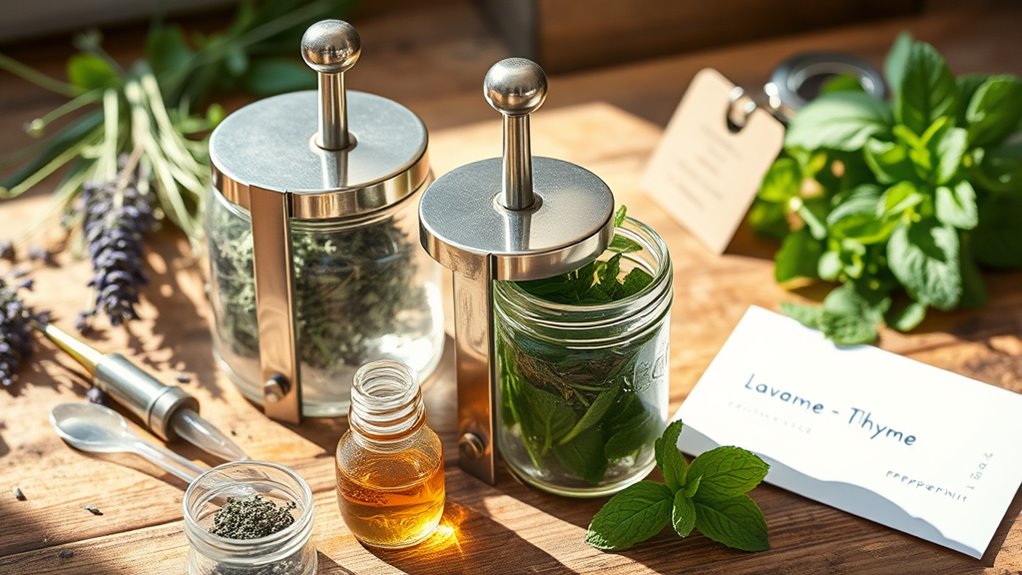
Herbal tincture press kits fall into two camps: purpose-built tincture presses designed to squeeze every drop of alcohol extract from marc, and adapted fruit and cheese presses that work for herbs but demand some improvisation. The MG Scientific Tincture Press US17 earns the top spot here because it was engineered specifically for botanical extraction, with drainage geometry and frame strength matched to the job. The LETIME Multi-Use Press follows closely for home herbalists who also press oils and honey, while the SAIISH 1L Lever-Handle Press is the easiest entry point for beginners making small batches. The main tradeoff across this category is yield and effort versus price and counter space — dedicated tincture presses recover more extract but cost more, while multi-use presses spread their value across the kitchen. Read on for the full breakdown of which press fits your batch size and budget.

Get furniture and decor delivered free — and shop member deals
- Fast, free delivery on millions of items
- Access to Prime Big Deal Days deals on October 6–7
- Prime Video, Amazon Music and more included
Complete the kit


Key Takeaways
- Purpose-built tincture presses like the MG Scientific US17 and SAIISH lever model extract noticeably more tincture from spent marc than repurposed fruit presses, because their cylinders concentrate force on a small, wet mass.
- Multi-use presses (LETIME, PNKKODW, and the basket-style wine presses) win on versatility but lose yield on small herbal batches — herbs settle into a thin layer across a wide basket where pressure disperses.
- Basket-style presses like the EJWOX, 12-Liter, and SQUEEZE master only make sense for herbalists pressing very large volumes or processing herbs alongside cider and cheese; they are overkill for quart-jar tincture batches.
- Material quality diverged sharply: stainless steel contact surfaces are non-negotiable for alcohol-based extracts, and several budget fruit presses use plated iron components that risk corrosion with high-proof menstruum.
- The Manual Cheese Press ranked lowest for tincture work despite solid build — its flat plate and screw design work for curd, not for compressing saturated herb packed in a filter bag.
| EJWOX Fruit Wine Press with Filter Bag |  | Best for Large Batch Herbal and Fruit Pressing | Brand: EJWOX | Style No.: 1112 | Color: Red | VIEW ON AMAZON | See Our Full Breakdown |
| MG Scientific Tincture Press US17 |  | Best Premium Lab-Grade Pick | Manufacturer: MG Scientific | Capacity: 1 Liter | Material: Stainless steel | VIEW ON AMAZON | See Our Full Breakdown |
| SAIISH Tincture Press with Jar and Lever Handle |  | Best for Beginners and Small Workspaces | Brand: SAIISH | Manufacturer: RAMA SCIENTIFIC INSTRUMENTS | Model Number: TPORAGE1L | VIEW ON AMAZON | See Our Full Breakdown |
| Manual Cheese Press, 1.6 Gallon Stainless Steel Basket |  | Best Multi-Purpose Value | Capacity: 1.6 gallons | Material: Stainless steel inner basket, metal frame | Operation: Manual screw press | VIEW ON AMAZON | See Our Full Breakdown |
| LETIME Multi-Use Press for Tinctures, Infused Oils, Honey, and Tea |  | Best Overall | Brand: LETIME | Material: 304 Stainless Steel | Capacity: 2 liters | VIEW ON AMAZON | See Our Full Breakdown |
| 12-Liter Stainless Steel Fruit and Wine Press |  | Best High-Capacity Option | Material: 304 stainless steel and galvanized steel | Capacity: 12 liters (3.17 gallons) | Inner bucket working volume: 6–7 liters (1.59–1.85 gallons) | VIEW ON AMAZON | See Our Full Breakdown |
| PNKKODW 0.53 Gal Manual Fruit Press, 2L Food Press for Cider, Wine, Cheese, Herbs, and Honey |  | Best for Small-Batch Tinctures | Brand: PNKKODW | Capacity: 0.53 gal (2 L) | Weight: 7.1 lb | VIEW ON AMAZON | See Our Full Breakdown |
| SQUEEZE master Manual Fruit and Wine Press, 1.6 Gallon (6 L), Stainless Steel and Iron |  | Best Middle-Ground Capacity | Brand: SQUEEZE master | Model: Cheese Tincture Herb Fruit Wine Manual Press | Capacity: 1.6 gallons (6 L) | VIEW ON AMAZON | See Our Full Breakdown |
| herbal tincture press kit | Capacity | Material | Brand |
|---|---|---|---|
| EJWOX Fruit Wine Press with Fi | — | Steel and stainless steel | EJWOX |
| MG Scientific Tincture Press U | 1 Liter | Stainless steel | — |
| SAIISH Tincture Press with Jar | 1 L | Stainless Steel | SAIISH |
| Manual Cheese Press | 1.6 gallons | Stainless steel inner basket, metal frame | — |
| LETIME Multi-Use Press for Tin | 2 liters | 304 Stainless Steel | LETIME |
| 12-Liter Stainless Steel Fruit | 12 liters (3.17 gallons) | 304 stainless steel and galvanized steel | — |
| PNKKODW 0.53 Gal Manual Fruit | 0.53 gal (2 L) | — | PNKKODW |
| SQUEEZE master Manual Fruit an | 1.6 gallons (6 L) | — | SQUEEZE master |
More Details on Our Top Picks
EJWOX Fruit Wine Press with Filter Bag
When your herbal preparations outgrow liter-scale equipment, the EJWOX fruit and wine press is where I’d point serious home producers. Its wide, stable stance and extension tube mean pressed liquid drains straight into your collection vessel without the spills that smaller benchtop units like the SAIISH 1 L press can create at capacity. The removable straining basket also makes cleanup less of a chore than fixed-basket designs.
The tradeoff is prep work: herbs and fruit must be chopped or pulped before pressing, and hard foods like whole lemons or nuts are off the table entirely. Filter bags are not included, so you’ll need to source your own herb-friendly mesh. Compared with the LETIME multi-use press, this is a bulk workhorse rather than a precision tincture tool — it trades finesse for volume.
Pros:- Multifunctional for juices, wine, cheese, and herbs
- Removable straining basket simplifies cleaning
- Stable wide stance with extension tube for tidy draining
- Preservative-free, natural extraction method
Cons:- Not suitable for nuts, whole lemons, or hard foods
- Fruits and herbs must be chopped or pulped first
- Filter bags not included and must be purchased separately
Best for: Home herbalists and winemakers processing large volumes of soft plant material who need capacity over precision
Not ideal for: Small-batch tincture makers — its size and chopping requirement make it overkill for liter-scale work
- Brand:EJWOX
- Style No.:1112
- Color:Red
- Product Size:13.5 x 10.2 x 8.3 inches
- Weight:10 lbs
- Material:Steel and stainless steel
- Includes Filter Bag:No
Our verdict“Choose this if volume matters more than precision — it’s the batching workhorse of this lineup, not a fine-extraction tool.”
MG Scientific Tincture Press US17
The MG Scientific Tincture Press US17 sits at the serious end of this lineup. Its extra heavy duty build, stainless steel disc, and perforated mesh vessel with a stopcock for controlled extraction give it a level of flow control that lever-style presses like the SAIISH simply can’t match — you decide exactly when and how fast your tincture drains, which matters when you’re working with valuable or potent preparations.
That precision comes at two costs. The 1 liter capacity is the smallest workable batch size here, making it a poor fit next to the 2-liter LETIME or the 1.6-gallon cheese press if throughput matters. And its lab-oriented design means you’re paying for scientific-grade construction that a casual home herbalist won’t fully exploit. This model is better suited to practitioners and educators than to kitchen-counter experimenters.
Pros:- Extra heavy duty construction built for frequent use
- Stainless steel disc and mesh contact surfaces
- Stopcock gives precise control over extraction flow
- Handles tinctures, decoctions, and infusions
Cons:- Limited to small 1 liter batches
- Niche scientific/lab product with a premium orientation
- Screw drive is slower than lever-assisted alternatives
Best for: Clinical herbalists, educators, and lab users who need controlled, repeatable small-batch extraction
Not ideal for: Hobbyists making larger batches — the 1 liter vessel and lab-focused design limit throughput and value
- Manufacturer:MG Scientific
- Capacity:1 Liter
- Material:Stainless steel
- Mechanism:Screw drive with stopcock
- Vessel:Stainless steel mesh inner perforated vessel
- Intended Use:Tinctures, decoctions, infusions, demonstration and scientific purposes
- Date First Available:May 19, 2016
Our verdict“This pick makes the most sense for practitioners who prize controlled extraction over batch size.”
SAIISH Tincture Press with Jar and Lever Handle
For someone just getting into tincture making, the SAIISH 1 L press removes most of the friction that stops beginners. The heavy-duty lever handle delivers strong mechanical advantage without the wrist strain of a pure screw drive like the MG Scientific US17, and the included collection jar keeps drips contained — a small thing that makes first attempts far less messy.
Its compact 5.12 x 5.12 x 12.6 inch footprint fits where the EJWOX or the 1.6-gallon cheese press never could, which is exactly why it earns the beginner slot. The compromises are real, though: manual pressing takes physical effort, the 1 liter capacity caps you at small batches, and it needs cleaning after every session to stay in good shape. Compared with the LETIME, it trades dishwasher convenience and measuring marks for a lower barrier to entry.
Pros:- Lever handle provides strong mechanical advantage for smooth pressing
- Included collection jar keeps the workspace clean
- Compact footprint fits small benches and counters
- Durable stainless steel construction
Cons:- Manual operation requires physical effort
- Needs cleaning after each use for best performance
- Best suited to small-batch extraction only
Best for: Beginners and students with limited bench space who want a complete, ready-to-use starter press
Not ideal for: Producers needing volume or automated assistance — the 1 liter size and manual effort cap output quickly
- Brand:SAIISH
- Manufacturer:RAMA SCIENTIFIC INSTRUMENTS
- Model Number:TPORAGE1L
- Capacity:1 L
- Color:Orange
- Material:Stainless Steel
- Weight:7.7 pounds
- Dimensions:5.12 x 5.12 x 12.6 inches
- Included Components:Collection jar, knob for hand press
Our verdict“A sensible first press: complete out of the box and space-friendly, as long as your batches stay small.”
Manual Cheese Press, 1.6 Gallon Stainless Steel Basket
If your kitchen work spans cheese, tofu, herbs, and tinctures, this 1.6-gallon manual press earns its place on versatility alone. The screw system delivers steady, even pressure — exactly what firm paneer and tofu demand — while the food-contact stainless steel basket and included filter bags handle herbal extraction and vegetable dehydration without extra purchases. That bundled filter bag detail gives it a practical edge over the EJWOX, which ships without them.
Capacity sits comfortably between the liter-scale SAIISH and the big 12-liter wine press, making it a genuine middle path. The catch is effort: manual screw pressing for a full 1.6-gallon load takes real work, and hard fruits must be pre-crushed before they go in. Compared with the LETIME, you give up measuring marks and dishwasher convenience in exchange for raw throughput and dairy capability.
Pros:- Consistent, even pressure for cheese, paneer, and firm tofu
- Versatile across herbs, tinctures, and vegetable dehydration
- Durable stainless steel food-contact basket
- Filter bags included and design detaches for easy cleanup
Cons:- Not suitable for hard fruits unless pre-crushed
- Manual operation requires significant physical effort at full capacity
Best for: Home food crafters who press cheese, tofu, and herbs and want one tool for all of it
Not ideal for: Tincture-only makers who want easy cleanup — the screw mechanism and large basket are more work than a dedicated small press
- Capacity:1.6 gallons
- Material:Stainless steel inner basket, metal frame
- Operation:Manual screw press
- Includes:Filter bags
- Intended Uses:Cheese, paneer, tofu, herbs, oil infusions, vegetable dehydration
- Note:Not suitable for hard fruits unless pre-crushed
Our verdict“The best pick if one press needs to do everything in a busy home kitchen, provided you’re willing to work for it.”
LETIME Multi-Use Press for Tinctures, Infused Oils, Honey, and Tea
This is the pick I’d put at the top of a tincture-focused roundup because it’s the only dedicated herbal separation tool here designed around the actual workflow: straining tinctures, infused oils, honey, and decoctions with minimal mess. The 2-liter receiver with volume marks lets you measure as you press — something none of the other picks offer — and 304 stainless steel construction plus dishwasher-friendly components make it the easiest to live with after the work is done.
Against the SAIISH, you get double the capacity and better cleanup; against the MG Scientific US17, you trade stopcock precision for everyday practicality and a broader use range. It isn’t flawless: the handle ball can’t go in the dishwasher, handmade filter cups show visible polishing lines, and pressing is still manual labor. But for herbalists who make tinctures weekly, the balance of capacity, cleanliness, and measurement is hard to beat.
Pros:- Durable 304 stainless steel construction
- 2-liter receiver with volume marks for measuring and mixing
- Dishwasher-friendly components for easy cleanup
- Handles tinctures, oils, honey, tea, coffee, and butter
Cons:- Handle ball is not dishwasher safe
- Handmade filter cups may show visible polishing lines
- Manual pressing takes more effort than powered methods
Best for: Regular tincture and infusion makers who want measuring capability, easy cleanup, and multi-preparation versatility in one tool
Not ideal for: Buyers needing precision flow control or large fruit-and-wine volumes — this is a liquid-separation tool, not a crusher
- Brand:LETIME
- Material:304 Stainless Steel
- Capacity:2 liters
- Receiver Features:Volumetric marks
- Dishwasher Safe:Yes, except handle ball
- Recommended Uses:Tinctures, infused oils, infused honey, tea, decoctions, coffee, butter
- Warranty:1 year
- Return Policy:30 days free return
Our verdict“The most complete package for dedicated herbal work — measuring, straining, and cleaning in one, at a sensible capacity.”
12-Liter Stainless Steel Fruit and Wine Press
For herbalists working in volume, this is the largest-capacity press in this lineup, and that changes what you can do with it. Where the PNKKODW 2L press limits you to small tincture batches, this 12-liter unit lets you press marc from multiple quart jars at once — a real advantage if you decant and re-press in bulk. The food-grade 304 stainless steel mesh basket is the standout here, resisting the corrosion and herb staining that plague painted iron presses like the SQUEEZE master.
One honest caveat: the “12-liter” headline is the outer bucket figure, while the working inner basket holds 6–7 liters. That’s still generous, but measure your typical batch before buying. Also note the galvanized steel in the frame — the food-contact surfaces are stainless, but the full build isn’t.
Pros:- Food-grade 304 stainless steel pressing components resist staining and corrosion from tannin-rich herbs
- True batch-scale capacity for pressing marc from multiple jars at once
- Reinforced mesh basket and base hold up under heavy repeated pressure
- Non-stick coating simplifies cleanup of sticky resins and honey
Cons:- The advertised 12-liter capacity overstates the actual 6–7 liter working volume of the inner basket
- Frame uses galvanized steel, so the entire build is not stainless
- Manual jack operation requires assembly and physical effort per batch
Best for: Small-batch producers and herbalists who press multiple quarts of marc at a time and want corrosion-resistant food-contact surfaces
Not ideal for: Apartment kitchens or anyone pressing single small jars — the footprint and setup time outweigh the capacity benefit
- Material:304 stainless steel and galvanized steel
- Capacity:12 liters (3.17 gallons)
- Inner bucket working volume:6–7 liters (1.59–1.85 gallons)
- Inner basket dimensions:19.5 cm diameter x 24 cm height
- Outer bucket dimensions:21 cm diameter x 25 cm height
- Operation:Manual jack
- Included components:Outer bucket, inner bucket, jack
Our verdict“Buy this if you press tinctures in volume and want stainless food-contact surfaces; skip it if your batches fit in a single mason jar.”
PNKKODW 0.53 Gal Manual Fruit Press, 2L Food Press for Cider, Wine, Cheese, Herbs, and Honey
Not everyone needs to press a gallon of marc at a time, and the PNKKODW leans into that reality. Its 2-liter capacity maps almost perfectly onto a standard double-quart tincture batch, so nothing sits around waiting for space in the basket. Compared with the 12-liter stainless press, it trades scale for bench-top practicality — at 7.1 pounds, it stays put on a counter and stores in a cabinet, which the bigger unit simply can’t do.
The tradeoff is straightforward: this is a hand-powered screw press, so yields depend on your patience and grip, and there’s no bypassing the physical work. Compared with lever-style presses like the SAIISH 1L tincture press, you get double the capacity but a less tincture-specific design — no jar-mounting system here.
Pros:- 2L capacity matches typical single-session home tincture batches
- Compact 7.1 lb build is stable on a counter and easy to store
- Handles herbs, nuts, seeds, and cheese beyond just fruit
- No electricity needed, so it works anywhere
Cons:- Small basket makes multi-jar sessions tedious
- Manual screw pressing demands real physical effort for dry, dense herb marc
- Sparse published specifications make build details hard to verify before purchase
Best for: Home herbalists making one or two quart jars of tincture at a time who want a compact, no-electricity press
Not ideal for: Anyone pressing more than a couple of jars per session — the 2L basket becomes a bottleneck fast
- Brand:PNKKODW
- Capacity:0.53 gal (2 L)
- Weight:7.1 lb
- Operation:Manual
- Power source:None (hand-powered)
- Recommended uses:Fruits, herbs, nuts, seeds, vegetables, cider, tinctures, honey
Our verdict“This is the right pick if your tincture routine is one or two jars at a time and counter space is limited.”
SQUEEZE master Manual Fruit and Wine Press, 1.6 Gallon (6 L), Stainless Steel and Iron
The SQUEEZE master occupies the sweet spot between the PNKKODW’s 2L basket and the 12-liter stainless press. Its 1.6-gallon (6 L) capacity handles a serious session of tincture marc without the industrial footprint, and the ball-handle leverage design makes sustained pressing less fatiguing than a plain screw knob — a genuine advantage when you’re working through several batches of dense root and bark marc.
The compromises are worth weighing. The stainless-and-iron construction means the frame isn’t fully stainless like the 12-liter unit, so long-term durability around acidic plant material is a question mark. And while the marketing cites quiet operation and strong juice yield, neither figure is independently verifiable — treat them as claims, not guarantees.
Pros:- 1.6-gallon capacity balances batch size against countertop footprint
- Ball handle provides better leverage than standard screw knobs on smaller presses
- Versatile across fruit, vegetables, cheese, olives, and herbs
- Quiet manual operation with no electricity required
Cons:- Iron components in the frame are less corrosion-resistant than full stainless builds
- Advertised juice yield and noise figures are manufacturer claims without independent verification
- Manual operation still requires sustained physical effort
Best for: Home brewers and herbalists who want more capacity than a benchtop press but less bulk than a 12-liter unit
Not ideal for: Buyers who need all-stainless food-contact construction or fully verified performance claims before purchasing
- Brand:SQUEEZE master
- Model:Cheese Tincture Herb Fruit Wine Manual Press
- Capacity:1.6 gallons (6 L)
- Materials:Stainless steel and iron
- Color:Red
- Power source:Manual
- Reported noise level:Approximately 35 dB (manufacturer claim)
Our verdict“A sensible middle path if the 2L presses feel too small and the 12-liter unit feels like too much machine.”

How We Picked
I judged every product through one specific lens: how well it recovers alcohol extract from saturated herb. That broke down into four criteria. First, pressure mechanics — a tincture press needs focused, controllable force on a compact mass, which favors lever and hydraulic designs over wide screw plates. Second, contact materials — any surface touching the extract must be stainless steel or food-grade polymer, since high-proof alcohol strips coatings and interacts with reactive metals. Third, batch-size fit — a press matched to quart-jar batches wastes less extract and effort than one sized for gallons of cider. Fourth, cleanup — pressed marc is sticky and fibrous, so presses with removable cylinders and smooth welds beat basket-and-slats designs with crevices.
The ranking logic follows those weights. Dedicated tincture presses sit at the top because they score well on all four. Multi-use presses occupy the middle because they trade some extraction efficiency for versatility. The large fruit and wine presses rank lower for this use case — not because they are poorly made, but because their design intent (volume juicing) works against small-batch herbal work. One basket press earns a spot for herbalists who also process fruit; another is included as a cautionary comparison so readers can see exactly where the money goes when versatility is prioritized.
| herbal tincture press kit | Brand |
|---|---|
| EJWOX Fruit Wine Press with Fi | EJWOX |
| MG Scientific Tincture Press U | — |
| SAIISH Tincture Press with Jar | SAIISH |
| Manual Cheese Press | — |
| LETIME Multi-Use Press for Tin | LETIME |
| 12-Liter Stainless Steel Fruit | — |
| PNKKODW 0.53 Gal Manual Fruit | PNKKODW |
| SQUEEZE master Manual Fruit an | SQUEEZE master |
Factors to Consider When Choosing Herbal Tincture Press Kits
Choosing among herbal tincture press kits comes down to matching the press design to your extraction volume and menstruum — the wrong match wastes both extract and money. These are the factors that actually change outcomes.Press Type: Purpose-Built vs. Adapted
The single biggest decision is whether to buy a press made for tinctures or to adapt one made for something else. Purpose-built tincture presses use a narrow cylinder with a follower plate, concentrating force into a compact column of marc — this is where extraction yield comes from. Fruit and wine presses spread herb across a wide slatted basket, so the same effort produces lower pressure per square inch and leaves more extract behind in the marc. A common mistake is assuming a bigger press is a better press; for quart-jar tincture batches, a 1–2 liter dedicated cylinder outperforms a 6-liter fruit basket. Adapted presses only earn their place when you genuinely press other things — cider, cheese, nut milk — often enough to justify the compromise.
Contact Materials and Alcohol Compatibility
High-proof alcohol is an aggressive solvent, and not just for plant constituents — it degrades coatings, leaches metals, and dissolves finishes that water-based juicing would never touch. 304 stainless steel is the baseline for any surface contacting the extract, including the follower plate, cylinder walls, and drip tray. Several budget fruit presses use painted or plated iron frames where drips are inevitable, and flaking paint into a tincture you’ll steep for six weeks is a real risk, not a theoretical one. Plastic components deserve scrutiny too: food-grade polyethylene is fine, but brittle plastics crack under lever pressure and become impossible to sanitize in the crevices. If a press lists only “stainless and iron” without specifying grades on contact parts, assume the worst and check replacement availability before buying.
Batch Size and Realistic Volume
Be honest about how much tincture you actually make before paying for capacity. A household herbalist pressing marc from a few quart jars needs something in the 0.5 to 2 liter range; anything larger takes longer to clean than the pressing itself saves. Larger presses (6 liters and up) make sense for small producers, community apothecaries, or anyone processing bulk dried herb by the pound. The mistake I see most often is buying for an aspirational volume — the person with twelve jars of tincture buying a 12-liter press that takes twenty minutes to disassemble and scrub for a two-minute pressing job. Match the press to the batch you make this season, not the one you imagine making someday.
Pressure Mechanism and Effort Required
Lever, screw, and hydraulic designs each produce different force profiles, and the differences matter more for herbs than for fruit. Lever presses deliver fast, incremental pressure that suits wet, slippery marc — you can squeeze, reposition, and squeeze again. Screw presses build slow, high force, which works well but requires patience and a sturdy mounting point, since the frame takes all the torque. Hydraulic presses generate the most force but introduce hoses and cylinders that complicate cleaning. For most home herbalists, the sweet spot is a lever or cam-style press with a long handle and a frame rigid enough not to flex — frame flex is the hidden flaw in cheap presses, and it converts your effort into frame bending instead of marc compression.
Cleanup and Marc Handling
Pressed herb is fibrous, sticky, and tends to wedge itself into every seam — cleanup is where cheap tincture press kits reveal themselves. Look for removable cylinders, smooth welded seams, and included filter bags sized to the press; a filter bag that fits loosely turns cleanup into a fifteen-minute scraping session. Slatted baskets from fruit presses are the worst offenders, since marc packs between the slats and stains. Also consider where the extract drains: a press with a spout or drip tray that directs into your collection jar prevents the splash-and-drip mess that high-proof alcohol makes on a counter. If you press weekly, cleaning time adds up faster than pressing time, and a simple cylinder design will save hours over a season.
When to Pay More (and When Not To)
Spending more on a tincture press buys three things: better steel, stiffer frames, and refined drainage geometry — all of which translate directly into yield and durability across years of use. For anyone pressing more than a few batches a month, the higher tier pays for itself in recovered extract alone, since a good press can pull an extra ounce or more of tincture from marc that a hand-squeeze leaves behind. Below that frequency, the economics flip, and a modest lever press or even a well-used adapted fruit press does the job adequately. The mistake to avoid is paying premium prices for capacity you won’t use — a stainless 12-liter basket press costs far more than a dedicated small tincture press and performs worse at the actual task. Pay for precision at your batch size, not volume you don’t have.
Frequently Asked Questions
Can I use a fruit or wine press for tinctures, or do I need a dedicated tincture press?
You can, and many home herbalists do — but the results differ in ways worth understanding. Fruit presses distribute pressure across a wide slatted basket, which works well for pulp but leaves extract in herb that spreads into a thin layer. A dedicated tincture press concentrates force in a narrow cylinder, so the same effort yields drier marc and more recovered tincture. If you already own a fruit press and make tinctures occasionally, lining the basket with a fine filter bag gets you acceptable results. If tinctures are your primary output, the dedicated press pays for itself in recovered extract within a season of regular batches.
How much tincture does a press actually recover compared to hand-squeezing?
The difference depends on how thoroughly you squeeze by hand and how wet your marc is, but a well-designed press typically recovers meaningfully more than hand pressure alone. Fine-root and leaf material holds menstruum in capillary spaces that hand strength can’t collapse, and a lever or hydraulic press applies force steadily for as long as you hold it. Practically, that can mean an extra pour or two from every quart jar of marc — over dozens of jars, that adds up to free medicine you were otherwise composting. The press also gives a more consistent squeeze, so batch-to-batch yields become predictable, which matters if you dose by volume.
Is high-proof alcohol safe to press through a stainless steel press?
Yes, provided the steel is genuinely food-grade — typically 304 stainless — on every surface the extract touches. High-proof alcohol is an excellent solvent and will strip paints, plastics of uncertain grade, and reactive metals, which is why iron frames with unknown coatings are a concern where drips land. The frame itself being iron is tolerable if it never contacts the tincture, but check the follower plate, cylinder, and drainage path specifically. After pressing, rinse contact parts promptly and dry them; even stainless can develop surface pitting if marc and alcohol sit in crevices for days.
What size tincture press do I need for home batches?
For most home herbalists working in pint and quart jars, a cylinder in the 0.5 to 2 liter range handles a typical pressing session without waste. Marc compresses dramatically under pressure, so even a full quart jar of soaked herb reduces to a fraction of its volume — meaning a small cylinder is less limiting than it sounds. Larger presses become worthwhile when you press marc by the gallon, run a small product line, or batch-process dried herb bought by the pound. A useful rule: if your pressing session takes less than ten minutes, your press is sized right; if you spend longer cleaning than pressing, you oversized it.
Do I need a filter bag, and can I use any cloth?
A filter bag makes pressing cleaner and measurably improves yield, because it lets the press squeeze a contained bundle of marc rather than pushing loose herb into drainage gaps. Presses that include a properly sized bag, like the EJWOX and several dedicated tincture models, save you the trial and error of sourcing one. Not any cloth works: the material needs fine weave to catch particles, enough strength to withstand lever pressure without tearing, and a fiber that tolerates high-proof alcohol — cotton and certain food-grade synthetics qualify, while loosely woven cheesecloth fails almost immediately. Have at least two bags in rotation so a wet one never slows down back-to-back batches.
Conclusion
The right pick depends entirely on what you press and how often. For best overall, the MG Scientific Tincture Press US17 leads on extraction efficiency, materials, and cleanup — it is the press built for exactly this job. For best value, the SAIISH 1L Lever-Handle Press delivers the core cylinder-and-lever design at an accessible price, and its included jar makes it the best choice for beginners pressing their first quart-jar batches. The LETIME Multi-Use Press earns best for small-batch versatility, handling infused oils, honey, and herb separation in one footprint. For herbalists who also make cider or press cheese in volume, the SQUEEZE master 6L and EJWOX basket presses serve double duty — accept lower tincture yields in exchange for range. The 12-liter press suits only high-volume producers, while the Manual Cheese Press is better skipped for tincture work. Match the press to your actual batch size, insist on stainless contact surfaces, and the extract you recover will justify the choice within a season.
Halloween Picks
halloween
As an affiliate, we earn on qualifying purchases.