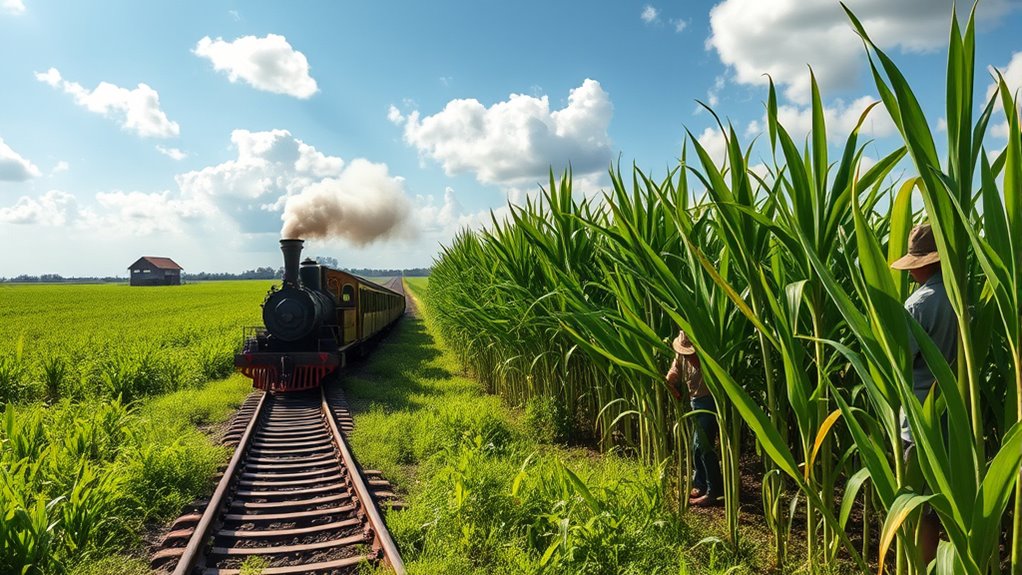

Plantation railways with narrow gauge tracks are essential for moving harvested cane efficiently across large fields to the sugar mill. They help you transport heavy loads quickly, reduce costs, and avoid delays in processing. Their design allows for sharp curves and uneven terrain, making navigation easier across sprawling plantation landscapes. This setup minimizes damage and keeps the crop fresh. Keep exploring to discover how these railways shape plantation operations and boost productivity.
Key Takeaways
- Plantation railways efficiently transport harvested cane from fields to sugar mills, ensuring minimal delays and maintaining freshness.
- Narrow gauge tracks allow for sharp curves and flexible layouts, adapting to uneven cane field terrains.
- Railway networks support high-volume, rapid movement of cane, reducing reliance on road transport and lowering operational costs.
- The design of plantation railways influences plantation layout, enabling easier access and minimizing field damage.
- The choice of narrow gauge enhances overall productivity and sustainability by optimizing transportation within plantation operations.
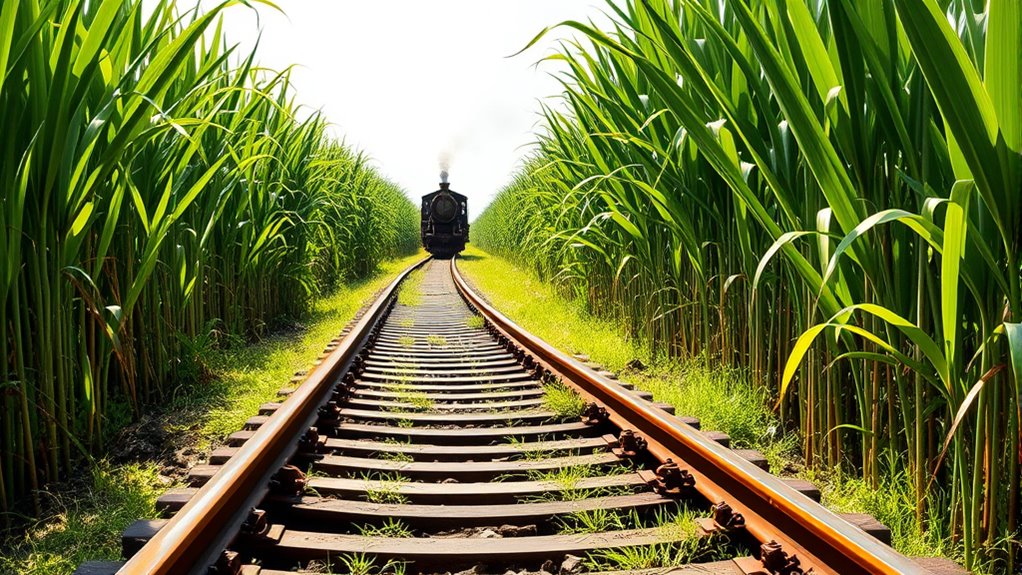
Have you ever wondered how sugar plantations manage to transport such massive quantities of cane efficiently? The answer lies in the clever design of plantation railways, which play a pivotal role in moving harvested cane from the fields to the sugar mill. These railways are specially engineered to handle the high volume of traffic and the weight of the cane, guaranteeing that the processing process stays smooth and continuous. One key aspect that influences their efficiency is the railway gauge—the distance between the rails. Plantation railways typically use narrow gauge tracks, which are more cost-effective to lay and maintain in the often uneven terrain of cane fields. Narrow gauges also allow for sharper curves and tighter turns, making it easier to navigate the sprawling plantation landscape without disrupting the crops or requiring extensive land clearance.
Plantation railways use narrow gauge tracks for efficiency and terrain flexibility.
As you follow the route of these railway lines, you’ll notice how they connect directly to the sugar mill, forming a critical link in the entire production chain. The cane is harvested and loaded onto specially designed wagons or carts that run along these rails. Because the gauge is optimized for carrying heavy loads, it minimizes the energy needed to transport the cane, reducing operational costs and increasing efficiency. Once the wagons reach the sugar mill, the cane is offloaded quickly, allowing the mill to begin processing without delay. This seamless movement from field to factory ensures that the cane remains fresh and unspoiled, which is essential for producing high-quality sugar.
The design of the railway gauge also influences the layout of the plantation itself. Since narrower gauges allow for a more flexible network, plantation managers can create intricate routes that snake through the fields, avoiding obstacles and making it easier to access all parts of the plantation. This flexibility means that the railway system can be expanded or modified as needed, supporting larger harvests or adapting to changes in the landscape. Moreover, the use of dedicated railway lines reduces the reliance on road transport, which can be more costly and less efficient in rural areas. It also minimizes road congestion and damage to the fields, making the entire operation more sustainable.
Furthermore, the choice of railway gauge impacts the overall efficiency of transportation, enabling large volumes of cane to be moved swiftly and safely, which is crucial for maintaining high productivity levels. In essence, the choice of railway gauge and the strategic placement of tracks connecting the fields to the sugar mill are key to the success of plantation railways. They enable large volumes of cane to be moved swiftly and safely, keeping the production process flowing smoothly. This infrastructure not only boosts productivity but also exemplifies how thoughtful engineering can transform agriculture into a highly efficient enterprise.

KATO Narrow Gauge Unitrack Straight Track 4.9 inches (124 mm), Pack of 4, 52-120 Model Railway Supplies
KATO Narrow Gauge Uni-Track Narrow Gauge Uni-Track Straight Track 124mm (4 pieces)
As an affiliate, we earn on qualifying purchases.
As an affiliate, we earn on qualifying purchases.
Frequently Asked Questions
How Did Plantation Railways Evolve Over Time?
You see, plantation railways evolved from simple horse-drawn carts to steam-powered and electric trains, enhancing transportation efficiency. Their historical significance lies in boosting crop movement and economic growth, while their ecological impact includes habitat disruption and pollution. Over time, modernization reduced ecological harm, but these railways remain essential for agricultural logistics. Your understanding of this evolution highlights how infrastructure adapts to balance progress with environmental concerns.
What Were the Primary Engineering Challenges Faced?
You might be surprised to learn that constructing early railways often required laying over 100 miles of track in remote areas. The primary engineering challenges included difficult terrain, unstable ground, and limited technology. You needed innovative solutions like reinforced bridges and specialized grading techniques. Railway construction demanded engineering innovations that improved stability and efficiency, allowing railways to traverse rugged landscapes and support expanding industries.
How Did These Railways Impact Local Communities?
You see, these railways considerably boosted local communities by spurring economic development, creating jobs, and improving transportation of goods. They also had a social impact, connecting people more easily and fostering regional growth. As a result, communities became more vibrant and prosperous. However, you should recognize that such developments sometimes brought challenges, like displacement or environmental concerns, which affected the social fabric in complex ways.
Were There Any Unique or Innovative Railway Designs Used?
Think of these railways as veins pulsing with innovation. You’ll find narrow gauge tracks designed to navigate tight corners and rugged terrain, showcasing clever engineering. Steam locomotives chug along these routes, proving their durability and efficiency in tough conditions. These designs weren’t just functional—they represented a bold leap forward, making transportation more adaptable and resilient, inspiring future engineering marvels that still influence railway innovations today.
What Is the Current Status of Remaining Plantation Railways?
You’ll find that many remaining plantation railways are now focused on historical preservation and modern adaptations. Some are still operational, serving as heritage attractions or for limited industrial use, while others stand abandoned or have been converted into scenic or tourist routes. These railways reflect a blend of history and innovation, helping you appreciate their cultural significance while adapting to contemporary needs and preservation efforts.

Evemodel C8763 1 Unit Painted 1:87 HO Scale 36' Wide Vision Caboose Wagons Model Railway (Brown)
Body mounted couplers. 33" metal DC wheels.
As an affiliate, we earn on qualifying purchases.
As an affiliate, we earn on qualifying purchases.
Conclusion
You can see how plantation railways truly boost efficiency, like in a sugar estate where trains quickly transport harvested cane to the mill. Imagine you’re working on a large farm, and without these railways, you’d spend hours moving crops manually. By using railways, you save time and increase productivity, ensuring your fields produce more. Ultimately, these railways are essential for smooth operations, helping you turn fields into thriving, productive landscapes with less effort.

Z MAYABBO Wooden Train Set Accessories Wood Railway Bridge for Railroad Tracks, 2-Level Overpass Compatible for All Railway Tracks System
Wooden train tracks accessories of lifting overpass bridge come with crossing tracks and bridge unit that moved up…
As an affiliate, we earn on qualifying purchases.
As an affiliate, we earn on qualifying purchases.

Little Pineapple: The Little Hawaiian Truck Discovers the Sugar Cane Trains
As an affiliate, we earn on qualifying purchases.
As an affiliate, we earn on qualifying purchases.