Countertop espresso machines range from budget-friendly steam-driven units to prosumer-grade machines with built-in grinders, and the right choice depends on how much control you want and how much counter space you can spare. The Breville Barista Express earns the best overall spot for its integrated conical burr grinder and precise extraction, essentially delivering a full café workflow in one footprint. If you want a fast, no-fuss milk-drink machine without the grinder complexity, the Breville Bambino stands out for its rapid heat-up and genuine 9-bar pressure in a compact body, while the De’Longhi Stilosa is the standout budget pick for anyone just starting out. The main tradeoff in this category is convenience versus control: entry-level machines simplify everything but limit shot quality, while semi-automatic machines reward practice with noticeably better espresso. Keep reading for the full breakdown of all 15 machines and which one fits your kitchen.

Get furniture and decor delivered free — and shop member deals
- Fast, free delivery on millions of items
- Access to Prime Big Deal Days deals on October 6–7
- Prime Video, Amazon Music and more included
Complete the kit


Key Takeaways
- Bar-count marketing dominated this lineup: nearly every machine here claims 15 or 20 bars, but true espresso extraction happens around 9 bars — the Breville Bambino and Barista Express outperformed higher-claimed machines because of stable temperature control, not pressure numbers.
- The steam wand divided the lineup more than any other feature: real steam wands (Casabrews 3700, De’Longhi Stilosa, Barista Express) produce microfoam for latte art, while milk frothers and 3.5-bar steam toys on the KEENSTAR and SHARDOR only make bubbly, soapy foam.
- The 3.5-bar machines (KEENSTAR, SHARDOR) are not true espresso makers — they’re moka-pot-style brewers, which explains their low cost and is why they sit at the bottom of this ranking.
- Counter footprint varied enormously: the CHULUX Slim and Casabrews CM5418 fit under cabinets where the Barista Express cannot, making machine depth the deciding factor for small kitchens, not price.
- A built-in grinder (only on the Barista Express) closes the biggest quality gap in this category — pre-ground coffee is the single biggest limiter on every other machine here.
| Breville Bambino Espresso Machine, Brushed Stainless Steel (BES450BSS) | 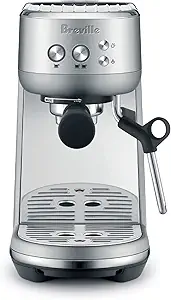 | Best Overall | Model: BES450BSS | Heating System: ThermoJet (3 second heat-up) | Portafilter Size: 54mm | VIEW LATEST PRICE | See Our Full Breakdown |
| Arecovas Espresso Machine, 20 Bar Pressure, Touch Screen, Milk Frother |  | Best for Long-Black Drinkers | Pressure: 20 bar | Power: 1300 watts | Water Tank Capacity: 41 oz (1.2L) removable | VIEW LATEST PRICE | See Our Full Breakdown |
| CASABREWS 3700 Essential Stainless Steel Espresso Machine with Steam Wand |  | Best Value | Pressure: 20 bar | Power: 1350 watts | Water Tank Capacity: 43.9 oz (removable) | VIEW LATEST PRICE | See Our Full Breakdown |
| CHULUX Slim Espresso Machine with Milk Frother, 20 Bar |  | Best Compact | Pump Pressure: 20 bar Italian pump | Heating Power: 1350 watts | Preheat Time: 30 seconds | VIEW LATEST PRICE | See Our Full Breakdown |
| Espresso Machine 20 Bar with Milk Frother, Stainless Steel Cappuccino Maker for Home & Office (Silver) |  | Best for Fast Mornings | Pressure: 20 bar with visible pressure gauge | Power: 1450 watts | Preheat Time: 20 seconds | VIEW LATEST PRICE | See Our Full Breakdown |
| Chefman CraftBrew Espresso Machine, 15-Bar Pump Digital Espresso Maker w/Steam Wand | 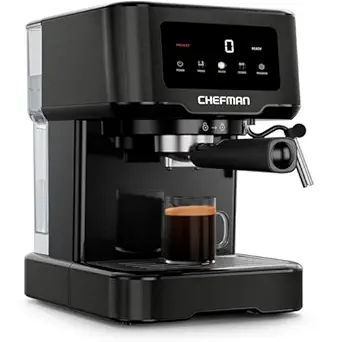 | Best Digital Controls for Beginners | Pump Pressure: 15 bar | Operation Mode: Semi-Automatic | Water Tank Capacity: 1.5 L removable | VIEW LATEST PRICE | See Our Full Breakdown |
| De’Longhi Classic Signature Espresso Machine with Adjustable Milk Frother |  | Best Premium Semi-Automatic | Pump Pressure: 15 bar Italian professional pump | Steam Wand: Adjustable 2-setting | Temperature Technology: Thermoblock | VIEW LATEST PRICE | See Our Full Breakdown |
| De’Longhi Stilosa Compact Manual Espresso Machine, Manual Milk Frother | 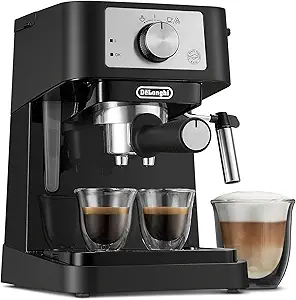 | Best Value Pick | Boiler: Stainless steel | Milk Frother: Manual steam wand | Portafilter: Ergonomic, with single and double filters | VIEW LATEST PRICE | See Our Full Breakdown |
| Aromaster 1400W Espresso Machine with Milk Frother, Stainless Steel |  | Best for Iced Coffee Drinkers | Power: 1400W | Pump Pressure: 20 bar | Temperature Control: PID + NTC | VIEW LATEST PRICE | See Our Full Breakdown |
| XIXUBX Espresso Machine with Milk Frother for Cappuccino & Latte, Silver |  | Best for Entertaining and Households | Pump Pressure: 20 bar | Water Tank Capacity: 42 oz (10+ cups per refill) | Steam Wand: 360° rotating, detachable | VIEW LATEST PRICE | See Our Full Breakdown |
| Gevi 20-Bar Compact Espresso Machine with Milk Frother | 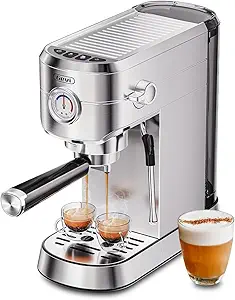 | Best for Aspiring Home Baristas | Pressure: 20 bars | Temperature Control: NTC | Brewing Type: Semi-automatic | VIEW LATEST PRICE | See Our Full Breakdown |
| KEENSTAR 3.5 Bar Espresso Machine with Steam Wand |  | Best Budget Starter Pick | Pressure: 3.5 bar | Power: 800W | Capacity: 1-4 cups (240ml) | VIEW LATEST PRICE | See Our Full Breakdown |
| CASABREWS CM5418 Compact Espresso Machine |  | Best Value for Genuine Espresso | Model: CM5418 | Pressure: 20 bar | Wattage: 1350 watts | VIEW LATEST PRICE | See Our Full Breakdown |
| SHARDOR 3.5 Bar Espresso Machine with Milk Frother |  | Best Ultra-Compact Desk Machine | Pressure: 3.5 bar | Heating Power: 800W | Boiler Material: Die-cast aluminum | VIEW LATEST PRICE | See Our Full Breakdown |
| Breville BES870XL Barista Express Espresso Machine |  | Best Premium All-in-One | Pressure: Low-pressure pre-infusion with 9-bar extraction | Grinder: Integrated conical burr, grind-on-demand | Temperature Control: PID digital regulation | VIEW LATEST PRICE | See Our Full Breakdown |
| countertop espresso machine | Power | Pressure | Material |
|---|---|---|---|
| Breville Bambino Espresso Mach | 1560 watts | — | — |
| Arecovas Espresso Machine | 1300 watts | 20 bar | Stainless steel |
| CASABREWS 3700 Essential Stain | 1350 watts | 20 bar | Stainless steel |
| CHULUX Slim Espresso Machine w | — | — | — |
| Espresso Machine 20 Bar with M | 1450 watts | 20 bar with visible pressure gauge | Stainless steel |
| Chefman CraftBrew Espresso Mac | 1350 watts / 120 volts | — | — |
| De’Longhi Classic Signature Es | — | — | Stainless steel |
| De’Longhi Stilosa Compact Manu | — | — | — |
| Aromaster 1400W Espresso Machi | 1400W | — | — |
| XIXUBX Espresso Machine with M | — | — | Stainless steel |
| Gevi 20-Bar Compact Espresso M | — | 20 bars | — |
| KEENSTAR 3.5 Bar Espresso Mach | 800W | 3.5 bar | BPA-free |
| CASABREWS CM5418 Compact Espre | — | 20 bar | Stainless steel |
| SHARDOR 3.5 Bar Espresso Machi | — | 3.5 bar | BPA-free |
| Breville BES870XL Barista Expr | 1600 watts, 120V | Low-pressure pre-infusion with 9-bar extraction | — |
More Details on Our Top Picks
Breville Bambino Espresso Machine, Brushed Stainless Steel (BES450BSS)
The Breville Bambino earns the top spot because it solves the two problems that frustrate budget machines most: slow heat-up and unstable temperatures. Its ThermoJet system reaches extraction temperature in 3 seconds, while PID control keeps shots consistent — a level of thermal precision none of the generic 20-bar options in this roundup can match. The automatic steam wand also texturates milk with less guesswork than the manual wands on the CASABREWS 3700 or CHULUX Slim, which demand real technique to avoid bubbly foam. The tradeoff for that speed is capacity and grind dependency: there is no built-in grinder (unlike the Breville Barista Express), so you need a separate quality grinder, and the compact body means a smaller footprint for multiple drinks back to back.
Pros:- 3-second ThermoJet heat-up is faster than anything else in this lineup
- PID temperature control delivers noticeably more consistent extraction
- Automatic steam wand produces latte-art-capable microfoam with minimal skill
- Includes a full accessory kit: milk jug, baskets, tamper, and cleaning tools
Cons:- No built-in grinder means an extra purchase and counter space for a separate unit
- 54mm portafilter is a non-standard size, limiting aftermarket accessory options
- Premium build costs more than functionally similar 20-bar machines like the CHULUX Slim
Best for: Coffee drinkers who already own a decent grinder and want café-quality shots and microfoam in a small kitchen
Not ideal for: Buyers wanting an all-in-one solution — without a grinder, this machine can’t produce good espresso from whole beans on its own
- Model:BES450BSS
- Heating System:ThermoJet (3 second heat-up)
- Portafilter Size:54mm
- Power:1560 watts
- Voltage:110-120V
- Settings:1 or 2 cups; hot water; steam
- Included Accessories:Single & dual wall baskets, milk jug, portafilter, tamper, cleaning tools
- Warranty:1 year limited
Our verdict“This is the pick for anyone who prioritizes shot consistency and speed over price and all-in-one convenience.”
Arecovas Espresso Machine, 20 Bar Pressure, Touch Screen, Milk Frother
The Arecovas stands out for one feature almost no compact machine offers: a dedicated Americano button that runs a 102-second extraction for a full 350 ml cup. Compared with the Breville Bambino, which is built purely for short shots, this model covers both espresso and long-black drinkers in one unit. Its PID algorithm with dual NTC sensors holding temperature within ±2°C gives it an edge over simpler machines like the CASABREWS 3700, and low-pressure pre-infusion helps even out extraction from uneven grinds. The touchscreen interface is slick, but it concentrates controls in a display that some users find slower to navigate mid-brew than physical buttons. Like most single-boiler machines, it still requires a temperature wait between steaming and brewing.
Pros:- Dedicated Americano mode delivers up to 350 ml without manual timing
- PID temperature control with dual sensors for shot-to-shot consistency
- Low-pressure pre-infusion reduces channeling and balances flavor
- Cup warmer on top and large 41 oz tank add everyday convenience
Cons:- Touchscreen interface may feel less intuitive than physical buttons for some users
- Single-boiler design still requires a wait when switching between brew and steam
- Brand’s long-term support and parts availability are less established than Breville’s
Best for: Households split between espresso purists and americano or long-black drinkers who want one machine for both
Not ideal for: Buyers who prefer simple physical controls — the touchscreen adds convenience but also a layer of menus to learn
- Pressure:20 bar
- Power:1300 watts
- Water Tank Capacity:41 oz (1.2L) removable
- Display:LED touchscreen with real-time pressure gauge
- Controls:One-touch single, double, and Americano
- Dimensions:12 x 5.2 x 11.9 inches
- Material:Stainless steel
- Included Accessories:Portafilter, 1- and 2-cup filters, tamper with spoon
Our verdict“This pick makes the most sense for anyone whose household drinks both straight espresso and full-size long blacks.”
CASABREWS 3700 Essential Stainless Steel Espresso Machine with Steam Wand
The CASABREWS 3700 delivers the core espresso experience — 20-bar pump, strong steam wand, stainless body — at a price point well below the Breville Bambino, and that value equation is exactly why it ranks here. Its 43.9 oz tank is the largest in this batch, edging out even the CHULUX Slim’s 40 oz, which means fewer refills when serving guests. The steam wand is genuinely capable of latte-art-grade microfoam, though it demands more manual technique than the Bambino’s assisted wand. What you give up is refinement: no PID temperature control like the Arecovas, no pressure gauge, and no pre-infusion, so dialing in consistent shots takes more trial and patience. Semi-automatic operation also means every step, from tamping to steam wand cleanup, is on you.
Pros:- Largest water tank in this batch at 43.9 oz for multiple drinks between refills
- Steam wand powerful enough for creamy microfoam and basic latte art
- Brushed stainless steel build looks more premium than the price suggests
- Includes everything needed to start: portafilter, two filter sizes, and tamper
Cons:- No PID or pressure gauge, so shot consistency depends heavily on user skill
- Steam wand needs thorough cleaning after every use to keep performing
- Grind quality matters more here than on temperature-stabilized machines
Best for: Budget-conscious buyers who want real espresso and milk drinks without paying for premium thermal tech
Not ideal for: Tinker-averse beginners who want repeatable results automatically — the lack of PID or presets makes each shot technique-dependent
- Pressure:20 bar
- Power:1350 watts
- Water Tank Capacity:43.9 oz (removable)
- Operation Mode:Semi-automatic
- Material:Stainless steel
- Coffee Input:Ground coffee
- Included Accessories:Portafilter, one-cup filter, two-cup filter, tamper with spoon
Our verdict“The smart choice for buyers who want capable hardware now and are willing to develop technique over time.”
CHULUX Slim Espresso Machine with Milk Frother, 20 Bar
At 5.5 inches wide, the CHULUX Slim is the narrowest machine in this roundup, and that footprint is its whole argument — it fits where the CASABREWS 3700 or Breville Bambino might feel cramped. Yet it refuses to feel like a stripped-down mini: the 40 oz tank beats most compacts, and it includes both a real-time pressure gauge and pre-infusion, features the cheaper CASABREWS 3700 lacks. Preheating in 30 seconds is respectable, though not Bambino-level instant. The compromises are practical rather than fundamental: a small drip tray fills quickly when pulling multiple shots, and extraction requires some dialing-in patience, which makes it less forgiving for a first-time espresso maker. For a dorm, office nook, or tiny apartment, those tradeoffs are easy to accept.
Pros:- Slimmest footprint in the lineup at 5.5 inches wide
- Pressure gauge and pre-infusion punch above the compact-machine weight class
- 40 oz tank is unusually large for a slim-format machine
- Auto shut-off after 25 minutes adds safety for office use
Cons:- Small drip tray needs frequent emptying during multi-shot sessions
- Extraction takes trial and error to master without guided presets
- 30-second preheat is slower than the premium ThermoJet alternatives
Best for: Anyone with genuinely tight counter space — dorms, offices, studio apartments — who still wants real 20-bar espresso
Not ideal for: Households making several milk drinks in a row — the small drip tray and steaming workflow slow down back-to-back service
- Pump Pressure:20 bar Italian pump
- Heating Power:1350 watts
- Preheat Time:30 seconds
- Width:5.5 inches
- Water Tank Capacity:40 oz
- Auto Shut-Off:After 25 minutes of inactivity
- Milk Frother:Steam wand
Our verdict“The narrow-body pick for space-limited counters that refuses to sacrifice gauge-guided extraction quality.”
Espresso Machine 20 Bar with Milk Frother, Stainless Steel Cappuccino Maker for Home & Office (Silver)
This unbranded 20-bar machine’s defining strength is speed: a 1450W heater that preheats in 20 seconds, faster than the CHULUX Slim (30 seconds) and nearly every other budget machine here outside the Breville Bambino. The visible pressure gauge helps you confirm extraction is on track, and the A4-sized footprint keeps it apartment-friendly. Where it trails the pack is workflow: unlike the Arecovas with its PID stabilization, this model has no temperature management beyond raw heating power, and single-boiler limits mean a cool-down period between frothing and brewing — awkward when you want a cappuccino in one sitting. Preheating before each use also adds ritual to what should be a quick morning. Still, for straight espresso with a quick steam finish, it moves at a pace most budget rivals can’t.
Pros:- 20-second preheat is among the fastest in the budget class
- Visible pressure gauge helps monitor extraction quality
- A4-sized footprint suits shared office or small kitchen counters
- Removable 34 oz tank and drip tray simplify daily cleanup
Cons:- Requires a cool-down period between frothing and brewing
- Must be preheated before every use, adding steps to the routine
- Smallest water tank in this batch at 34 oz
Best for: Commuters and office users who mainly pull quick espresso shots and value minimal wait time
Not ideal for: Latte and cappuccino drinkers making milk-heavy drinks daily — the steam-to-brew cool-down wait breaks the flow
- Pressure:20 bar with visible pressure gauge
- Power:1450 watts
- Preheat Time:20 seconds
- Water Tank Capacity:34 oz (removable)
- Dimensions:5.3 x 12.2 x 11.5 inches
- Material:Stainless steel
- Type:Semi-automatic espresso machine
Our verdict“A sensible pick for shot-first drinkers who prize fast startup over milk-drink workflow.”
Chefman CraftBrew Espresso Machine, 15-Bar Pump Digital Espresso Maker w/Steam Wand
The Chefman CraftBrew stands out for its touch control panel with programmable shot volume, which lets a first-time espresso maker dial in a ristretto, normale, or lungo without guessing. Compared with the De’Longhi Stilosa, which relies on manual stopping and timing by eye, this model removes most of the learning curve. The auto descale alert after 500 cycles is a maintenance nicety that similarly priced rivals like the XIXUBX don’t offer, and the 1.5L removable tank refills at the sink rather than in place. Tradeoffs are real, though: a 15-bar pump without a visible pressure gauge gives less extraction feedback than the XIXUBX, and the plastic-forward build feels less substantial than the stainless De’Longhi Classic Signature.
Pros:- Programmable shot volume for ristretto, normale, and lungo styles
- Touch control panel simplifies the learning curve for new users
- Removable 1.5L tank fills and cleans at the sink
- Automatic descale alert after 500 brewing cycles
Cons:- No pressure gauge for monitoring extraction quality
- Build quality leans plastic compared with stainless rivals
Best for: Beginners who want programmable shot sizes and guided maintenance instead of manual guesswork
Not ideal for: Buyers who want to monitor and tune extraction pressure — there’s no gauge, unlike the XIXUBX or De’Longhi Classic Signature
- Pump Pressure:15 bar
- Operation Mode:Semi-Automatic
- Water Tank Capacity:1.5 L removable
- Steam Wand:Built-in, for latte and cappuccino
- Controls:Digital touch panel with timer
- Power:1350 watts / 120 volts
- Dimensions:10.8″D x 8.9″W x 11.9″H
Our verdict“This pick makes the most sense for espresso newcomers who want digital presets and low-fuss upkeep over hands-on control.”
De’Longhi Classic Signature Espresso Machine with Adjustable Milk Frother
De’Longhi’s Classic Signature earns its spot through the details cheaper machines skip: a chrome visual pressure gauge so you can confirm proper extraction, Thermoblock fast temperature control for quick heat-up and stable shots, and a two-setting steam wand that produces actual microfoam rather than merely hot milk. Compared with the Chefman CraftBrew, the stainless construction and gauge give it a more serious, longer-lasting feel, and unlike the De’Longhi Stilosa below, it adds one-touch single/double presets and an adjustable double-height drip tray that fits taller glassware. The honest tradeoffs: the wand’s two fixed settings limit frothing flexibility compared with the Aromaster’s 360° swivel, and there’s no built-in grinder — if you want all-in-one convenience, the Breville Barista Express covers that at a higher cost.
Pros:- Visual pressure gauge helps you verify proper 9-bar extraction
- Thermoblock heating delivers fast start-up and stable shot temperatures
- 2-setting steam wand produces microfoam suitable for latte art
- Adjustable double-height drip tray accommodates tall glasses and cups
Cons:- Steam wand offers only two settings, limiting frothing control
- No built-in grinder, so fresh grounds require a separate purchase
Best for: Home baristas ready to step up from entry-level machines and learn dialing with pressure feedback
Not ideal for: Anyone wanting grind-and-brew in one unit — a separate grinder is required, unlike the Breville Barista Express
- Pump Pressure:15 bar Italian professional pump
- Steam Wand:Adjustable 2-setting
- Temperature Technology:Thermoblock
- Preset Recipes:Single or double espresso, one-touch
- Drip Tray:Double height, adjustable
- Material:Stainless steel
Our verdict“This model is better suited to buyers who want durable stainless construction and real brewing feedback than to set-and-forget users.”
De’Longhi Stilosa Compact Manual Espresso Machine, Manual Milk Frother
The De’Longhi Stilosa wins on simplicity and price-to-performance. Its stainless steel boiler is built for years of consistent work rather than the plastic-heavy internals common at this tier, and the manual milk frother handles respectable cappuccinos and flat whites. Where the Chefman CraftBrew automates shot volume digitally, the Stilosa asks you to stop the brew yourself — a fair exchange for the lower cost, and arguably better for learning fundamentals. The two-level cup holder adds flexibility the most basic 3.5-bar machines like the KEENSTAR can’t match, and the compact footprint rivals the CHULUX Slim for tight counters. Drawbacks: no programmability, no pressure gauge, and the frother takes practice before it produces microfoam close to the De’Longhi Classic Signature’s output.
Pros:- Stainless steel boiler engineered for long-term durability
- Two filters for single or double espresso shots
- Two-level cup holder fits a range of cup sizes
- Compact footprint suits small kitchens and apartments
Cons:- Fully manual operation with no presets or programmability
- Steam wand requires technique to produce quality microfoam
Best for: Budget-conscious buyers who want a durable, name-brand starter machine without paying for digital extras
Not ideal for: Anyone who wants presets or hands-off brewing — every shot requires manual timing and stopping
- Boiler:Stainless steel
- Milk Frother:Manual steam wand
- Portafilter:Ergonomic, with single and double filters
- Cup Holder:Two-level for multiple cup sizes
- Design:Compact countertop footprint
- Drinks:Espresso, cappuccino, latte, flat white
Our verdict“The most sensible entry point for a first espresso machine if you’re willing to trade convenience for a lower price and dependable build.”
Aromaster 1400W Espresso Machine with Milk Frother, Stainless Steel
The Aromaster differentiates itself with a dual-circuit system built for switching between hot espresso and iced drinks back-to-back, plus PID+NTC temperature control — a level of thermal stability you normally find on pricier machines like the Breville Barista Express. The 360° swivel steam wand with a heat-resistant grip offers more positioning freedom than the De’Longhi Classic Signature’s two-setting wand, and one-touch descaling plus auto shut-off keep maintenance light. Its compact 7-inch width is narrower than the XIXUBX, fitting tighter counters. The catch is capacity: a small 2.4 oz brewing capacity limits larger drinks in one pass, and semi-automatic operation still involves a learning curve — it’s less plug-and-play than the Chefman CraftBrew’s digital presets.
Pros:- Dual-circuit heating supports back-to-back hot and iced drinks
- PID+NTC temperature control for shot-to-shot consistency
- 360° swivel steam wand with heat-resistant grip for latte art
- One-touch descaling, auto shut-off, and anti-dry burn protection
Cons:- Small 2.4 oz brewing capacity limits larger drinks
- Semi-automatic workflow demands some beginner learning
Best for: Iced-latte and hot-drink switchers who want precise temperature control in a narrow footprint
Not ideal for: Households that brew large milk-heavy drinks in single passes — the small brew capacity means multiple cycles
- Power:1400W
- Pump Pressure:20 bar
- Temperature Control:PID + NTC
- Water Tank Capacity:37 oz removable
- Steam Wand:360° swivel
- Special Features:Pre-infusion, one-touch descaling, auto shut-off, cup warmer
- Dimensions:13″D x 7″W x 14″H
Our verdict“A strong fit for iced-coffee lovers who value temperature precision and safety features over big-batch brewing.”
XIXUBX Espresso Machine with Milk Frother for Cappuccino & Latte, Silver
Where most compact machines run out of steam after two lattes, the XIXUBX carries a 42 oz tank rated for 10+ cups per refill, making it the practical choice for brunches and busy households. Its visible pressure gauge lets you watch extraction climb toward the ideal 9 bar — feedback the Chefman CraftBrew lacks — and the bundle includes a stainless frothing pitcher, an accessory most rivals here leave out. The instant heating system keeps brew and steam cycles moving without long cooling gaps, unlike single-boiler budget machines such as the De’Longhi Stilosa. Tradeoffs: the stainless body is stylish but the machine takes up more counter space than the slim CHULUX, and as a lesser-known brand its long-term support and resale track record trail De’Longhi’s established reputation.
Pros:- 42 oz tank brews 10+ cups before refilling
- Visible pressure gauge for real-time extraction monitoring
- Detachable 360° steam wand simplifies cleaning
- Includes stainless milk frothing pitcher and 1-year warranty
Cons:- Larger footprint than slim competitors like the CHULUX
- Unproven brand track record compared with established names like De’Longhi
Best for: Families and hosts who brew multiple drinks back-to-back and want extras included out of the box
Not ideal for: Brand-conscious buyers who prioritize established manufacturer support and proven long-term reliability
- Pump Pressure:20 bar
- Water Tank Capacity:42 oz (10+ cups per refill)
- Steam Wand:360° rotating, detachable
- Pressure Monitoring:Visible analog pressure gauge
- Included Accessories:Stainless steel milk frothing pitcher
- Material:Stainless steel
- Warranty:1 year
Our verdict“The clear pick when serving a crowd matters more than brand prestige — big tank, pressure feedback, and included accessories cover the hosting basics.”
Gevi 20-Bar Compact Espresso Machine with Milk Frother
This option stands out for its pre-infusion stage and pressure gauge, two features usually reserved for pricier machines like the Breville Barista Express. Pre-infusion saturates the coffee puck gently before full pressure kicks in, which translates into fewer sour or bitter shots for someone still learning their technique. Compared with the CASABREWS CM5418, which also runs a 20-bar pump, the Gevi adds a hot water function for Americanos and tea, plus a removable froth nozzle that simplifies cleanup. The tradeoff is that semi-automatic operation still demands skill — dose, grind, and tamp all fall on the user, so results vary until technique improves. Capacity details are also thin, which matters if you entertain.
Pros:- Pre-infusion and pressure gauge help diagnose and improve extraction quality
- Steam wand produces genuine microfoam suitable for latte art
- Hot water function adds Americano and tea versatility most compact rivals lack
- Full stainless steel housing feels more durable than plastic-bodied competitors
Cons:- Semi-automatic operation still requires user skill for consistent results
- No published water tank capacity or cup-warmer details, making planning harder
- Requires a separate quality grinder to realize its extraction potential
Best for: Beginners ready to graduate from steam-toy machines and learn real espresso technique with feedback tools like a pressure gauge
Not ideal for: Buyers who want push-button simplicity — the learning curve here is real, and inconsistent tamping produces inconsistent shots
- Pressure:20 bars
- Temperature Control:NTC
- Brewing Type:Semi-automatic
- Key Features:Pre-infusion, pressure gauge, steam wand, hot water function
- Housing:Full stainless steel
- Froth Nozzle:Removable
- Warranty:12 months with lifetime tech support
Our verdict“A smart stepping stone for hobbyists who want feedback-driven learning tools without paying Breville money.”
KEENSTAR 3.5 Bar Espresso Machine with Steam Wand
The KEENSTAR makes sense for someone who wants milk-based coffee drinks without a barista apprenticeship. Its single-knob control with pause function is friendlier than the dial-and-gauge workflow on the Gevi 20-bar, and it brews up to four cups in about two minutes — quicker than anything else in this lineup. The honest tradeoff is pressure: at 3.5 bars, this is espresso-style coffee, not true espresso, so purists chasing thick crema should step up to a 20-bar model like the CASABREWS CM5418. The 240ml water limit is also tight; overfill it and the nozzle leaks, which forces careful measuring every single morning.
Pros:- Brews up to 4 cups in roughly 2 minutes
- Steam wand produces micro-foam in about 40 seconds
- At 4.7 lbs and under 8 inches wide, it genuinely fits anywhere
- Single-knob operation with pause function is foolproof for novices
Cons:- 240ml water capacity is restrictive and leaks if overfilled
- Steam wand requires manual cleaning after every use
- Only works with medium-ground coffee; fine grinds cause problems
Best for: Students, dorm residents, and casual latte drinkers who want fast, frothy drinks with near-zero learning curve
Not ideal for: Espresso enthusiasts — 3.5 bars of steam pressure simply cannot produce authentic concentrated shots or dense crema
- Pressure:3.5 bar
- Power:800W
- Capacity:1-4 cups (240ml)
- Brewing Time:About 2 minutes
- Steam Wand Heat-Up:40 seconds
- Dimensions:13.1″ H x 7.7″ W x 10″ D
- Weight:4.7 lbs
- Material:BPA-free
Our verdict“A fair trade for the price-conscious buyer who prioritizes convenience and speed over espresso authenticity.”
CASABREWS CM5418 Compact Espresso Machine
For buyers who want real 20-bar extraction at a compact footprint, the CM5418 hits a sweet spot the steam-driven machines can’t touch. The 34 oz removable tank means refilling every few days rather than every few cups — a practical edge over the KEENSTAR’s tiny 240ml limit — and the 1350W boiler recovers faster between drinks. Unlike the Gevi, though, the CM5418 cannot brew immediately after steaming milk; the machine needs to cool down first or it may trip overheat protection, which slows down multi-drink mornings. Results also hinge on grind quality and tamping, so budget for a decent grinder alongside it.
Pros:- 20-bar pump with pressure gauge enables genuinely customizable extraction
- 34 oz detachable water tank supports multiple drinks between refills
- Steam wand textures milk well enough for latte art
- Brushed stainless steel build looks at home in a kitchen or office
Cons:- Cannot brew right after frothing; cool-down required or overheat protection triggers
- Demands correct grind size and tamping pressure to perform well
- No hot water function, unlike the Gevi
Best for: Small-kitchen or office espresso drinkers who want authentic shots and multi-cup capacity without a large footprint
Not ideal for: Hosts who regularly make back-to-back lattes — the mandatory cool-down between frothing and brewing kills pacing
- Model:CM5418
- Pressure:20 bar
- Wattage:1350 watts
- Water Tank:34 oz removable
- Operation Mode:Semi-automatic
- Material:Stainless steel
- Included:Portafilter, 1 & 2 cup filters, tamper with spoon, manual
Our verdict“The strongest compromise between price, footprint, and authentic espresso quality for small-space buyers.”
SHARDOR 3.5 Bar Espresso Machine with Milk Frother
At just 6 inches wide, the SHARDOR is the most space-efficient option in this roundup — narrower even than the KEENSTAR, and small enough for a desk or dorm shelf. Its one-knob control and built-in overheat and overpressure protection make it about as low-risk as an espresso machine gets, which suits environments where nobody is babysitting the brew. Compared with the KEENSTAR, the SHARDOR counters with a die-cast aluminum boiler and an adjustable steam wand for better frothing angles. But the same ceiling applies: 3.5 bars produces moka-pot-strength coffee, not the syrupy shots a 20-bar machine like the CASABREWS delivers. This is a milk-coffee convenience device, not a barista tool.
Pros:- Narrowest footprint in the lineup; fits desks and tight shelves
- 800W die-cast aluminum boiler heats and brews quickly
- Adjustable steam wand gives better frothing control than fixed wands
- Overheat and overpressure protection adds safety for unattended use
Cons:- 3.5-bar pressure yields espresso-style coffee, not true high-pressure espresso
- Best for casual drinkers; enthusiasts will find the results thin
- Small capacity means frequent refills when making multiple drinks
Best for: Dorm, office-desk, and RV users who value a tiny footprint and safe, simple operation above espresso purity
Not ideal for: Anyone chasing true café-quality espresso — the low-pressure system caps what this machine can extract
- Pressure:3.5 bar
- Heating Power:800W
- Boiler Material:Die-cast aluminum
- Dimensions:11.8″ H x 8.3″ D x 6″ W
- Milk Frother:Adjustable steam wand
- Control:One-knob
- Safety Features:Overheat and overpressure protection
- Material:BPA-free
Our verdict“Choose it when counter space is the deciding factor, and accept lighter coffee in exchange.”
Breville BES870XL Barista Express Espresso Machine
The Barista Express earns its premium slot by solving the problem every other machine here punts on: the integrated conical burr grinder. Grind freshness is the single biggest variable in espresso quality, and going from beans to a shot in under a minute removes the guesswork (and the separate grinder purchase) that the Gevi and CASABREWS require. Add PID digital temperature control and low-pressure pre-infusion, and shot consistency climbs well above anything in this batch. The tradeoffs are physical and financial: at 22 pounds and roughly 13.8 inches deep, it dominates a small counter, and its manual operation means a genuine learning curve. For buyers who already own a grinder, the Breville Bambino becomes the smarter, cheaper route to similar shots.
Pros:- Integrated conical burr grinder with grind-size dial eliminates a separate grinder purchase
- PID temperature regulation and pre-infusion deliver noticeably more consistent shots
- Manual steam wand produces true microfoam for latte art
- 67 oz water tank and 1/2 lb bean hopper support extended use between refills
Cons:- Large and heavy at 22.1 lbs; demands serious counter real estate
- Manual operation carries a real learning curve before shots dial in
- Grinder settings require experimentation when switching beans
Best for: Coffee lovers ready to invest in a bean-to-cup workflow with precise, repeatable temperature and grind control
Not ideal for: Small kitchens or occasional drinkers — the size, weight, and price are hard to justify for a weekend cappuccino
- Pressure:Low-pressure pre-infusion with 9-bar extraction
- Grinder:Integrated conical burr, grind-on-demand
- Temperature Control:PID digital regulation
- Water Tank:67 oz
- Bean Hopper:1/2 lb
- Power:1600 watts, 120V
- Portafilter:54mm stainless steel
- Dimensions:13.8″ D x 12.5″ W x 15.9″ H
- Warranty:1 year limited
Our verdict“The complete package for a committed home barista who wants café results without buying separate equipment.”

How We Picked
I evaluated each machine against four criteria that actually determine daily satisfaction with countertop espresso machines: shot quality potential (stable pump pressure and temperature, not advertised bar counts), milk texturing capability (true steam wand versus frothing aid), footprint and build quality relative to the price tier, and day-to-day usability including warm-up time, water tank access, and cleaning routine. Machines were then ordered by how well they balance those factors — a cheap machine that delivers genuinely good espresso ranks above an expensive one that’s frustrating to live with.
The ranking logic also accounts for upgrade pathways. Machines that accept a separate grinder and standard accessories (Bambino, Casabrews 3700) score higher than closed ecosystems, because buyers can improve results over time without replacing the machine. Conversely, steam-driven units were ranked strictly on value for very occasional use, since they can’t produce true espresso no matter the technique. Where two machines tie on performance, the tiebreaker went to warranty support, parts availability, and how forgiving the machine is for a beginner’s first hundred shots.
| countertop espresso machine | Material |
|---|---|
| Breville Bambino Espresso Mach | — |
| Arecovas Espresso Machine | Stainless steel |
| CASABREWS 3700 Essential Stain | Stainless steel |
| CHULUX Slim Espresso Machine w | — |
| Espresso Machine 20 Bar with M | Stainless steel |
| Chefman CraftBrew Espresso Mac | — |
| De’Longhi Classic Signature Es | Stainless steel |
| De’Longhi Stilosa Compact Manu | — |
| Aromaster 1400W Espresso Machi | — |
| XIXUBX Espresso Machine with M | Stainless steel |
| Gevi 20-Bar Compact Espresso M | — |
| KEENSTAR 3.5 Bar Espresso Mach | BPA-free |
| CASABREWS CM5418 Compact Espre | Stainless steel |
| SHARDOR 3.5 Bar Espresso Machi | BPA-free |
| Breville BES870XL Barista Expr | — |
Factors to Consider When Choosing Countertop Espresso Machines
Before choosing between these machines, it helps to understand what actually drives espresso quality and what marketing language tends to obscure. These are the factors I’d weigh before spending anything in this category.Pump Pressure: Ignore the Big Numbers
Almost every machine in this category advertises 15 or 20 bars, and almost none of that matters. Proper espresso extracts at roughly 9 bars of stable pressure — higher peak ratings say nothing about whether a machine can hold that pressure evenly through a shot. The bigger differentiator is pump-driven versus steam-driven: 3.5-bar machines like the KEENSTAR and SHARDOR use steam pressure alone, which physically cannot reach espresso extraction range and produces something closer to strong moka-pot coffee. If authentic espresso is the goal, a vibratory pump machine at any price beats a steam machine at any price. This single distinction explains the largest price gaps in the category, so check it before comparing anything else.
Grinder Situation: The Hidden Cost
Coffee starts going stale within minutes of grinding, which means pre-ground coffee caps the quality of every machine on this list except the Barista Express. Buyers often spend heavily on a machine and then feed it stale grounds, then blame the machine. If you choose anything without a built-in grinder, budget for a burr grinder — even a modest one transforms results more than a machine upgrade would. Blade grinders are not a substitute; their inconsistent particle sizes cause simultaneous over- and under-extraction. The practical math: a mid-range machine plus a decent grinder usually outperforms a premium machine on pre-ground beans, which is why the Bambino ranks so highly despite being grinder-less.
Milk Frothing: Steam Wand vs. Frother
There’s a real capability gap between a true steam wand and a milk frothing attachment. A proper wand with adequate boiler capacity can create microfoam — the glossy, paint-like texture needed for cappuccinos and latte art. Frothing aids and underpowered wands on compact machines aerate milk into coarse, dry foam that separates quickly. If your daily drink is a latte or cappuccino, this feature matters as much as shot quality. Also check whether the wand is manual or automatic: automatic systems (like De’Longhi’s adjustable frother) trade texture control for consistency, a reasonable tradeoff for beginners. Single-boiler machines also force you to wait between brewing and steaming, which adds a minute to milk-drink routines — a daily annoyance that spec sheets never mention.
Footprint and Counter Real Estate
Measure your counter before buying, including height clearance under cabinets, because machines need several inches of headroom to refill the water tank and load the portafilter. The Barisa Express-class machines are deep and tall enough to become permanent fixtures; slim towers like the CHULUX fit where nothing else will. Water tank capacity matters more than it seems: a small tank means refilling daily, and if the tank isn’t removable or is rear-loading, you’ll be pulling the whole machine forward constantly. Also consider cup clearance — some compact machines can’t fit a standard mug under the spout without removing the drip tray, which gets old fast.
Ease of Maintenance and Descaling
Espresso machines need regular descaling, and how easily that happens varies widely. Removable drip trays, accessible water tanks, and clear descale indicators (present on the Breville and De’Longhi models) make routine care a five-minute job; machines with fixed internals turn it into a chore that gets skipped, which kills machines early. Steam wand hygiene is the other daily task: wands must be purged and wiped immediately after each use or milk residue bakes on and blocks the tip. Beginners routinely underestimate this. If you know you won’t maintain a machine diligently, a simpler machine with fewer failure points — like the Stilosa — will actually last longer than a feature-rich one you neglect.
Learning Curve: How Much Effort You Want to Invest
This category splits into machines that reward skill and machines that remove skill from the equation. Semi-automatic machines with manual portafilter dosing (Casabrews, Stilosa, Barista Express) have a real learning curve — expect thirty to fifty mediocre shots before things click. Touchscreen and one-touch machines like the Arecovas trade that ceiling for immediate consistency, which is legitimate if you want decent coffee without a hobby. The honest question is how you’ll feel about a bad shot on a rushed weekday morning. Buyers who overestimate their patience often end up using a manual machine as an expensive drip brewer, so match the machine’s demands to your actual routine, not your aspirational one.
Frequently Asked Questions
Is a 20-bar espresso machine really better than a 9-bar or 15-bar one?
No, and this is one of the most persistent marketing myths in the category. Espresso is extracted at around 9 bars of pressure; machines advertising 15 or 20 bars are quoting their pump’s maximum capability, not what actually reaches the coffee, because an over-pressure valve bleeds off the excess. What separates good machines is how stably they hold extraction pressure and temperature through a 25–30 second shot, which is why the 9-bar-rated Breville Bambino outperforms budget machines claiming 20 bars. When comparing models, ignore the bar count entirely and look instead for a quality pump, a proper portafilter size (54mm or 58mm is a good sign), and evidence of temperature stability. Those factors predict shot quality far better than the number on the box.
Do I need a built-in grinder like the Barista Express has?
A built-in grinder is the single biggest quality upgrade in this category because pre-ground coffee goes stale within about 15 minutes of grinding, and no machine can compensate for stale grounds. The Barista Express solves this in one footprint, which is why it ranks highest overall. However, a separate burr grinder paired with a machine like the Bambino gives you more flexibility — you can upgrade the grinder later, use it for other brew methods, and replace either component independently. The main arguments against the all-in-one approach are counter space and the fact that a grinder failure takes your whole coffee station down. If you drink one or two shots a day and value simplicity, all-in-one wins; if you’re likely to tinker and upgrade over time, separate components are the better long-term play.
Can a 3.5-bar machine like the KEENSTAR or SHARDOR make real espresso?
Technically no, and it’s worth understanding why before buying one. Espresso by definition requires roughly 9 bars of pressure forced through finely ground, tightly packed coffee; steam-driven machines max out around 3.5 to 5 bars, which is closer to how a stovetop moka pot works. The result is a strong, concentrated coffee that can still taste pleasant in milk drinks, but it lacks the crema, body, and balance of true espresso. That doesn’t make these machines useless — they’re cheap, simple, low-maintenance, and fine for occasional cappuccino-style drinks. But if you’ve had espresso at a good café and want to reproduce that at home, spending more on a pump machine like the De’Longhi Stilosa is the realistic minimum.
What’s the real difference between the Breville Bambino and the Barista Express?
The core difference is the grinder: the Barista Express has a built-in conical burr grinder and dose control, while the Bambino is brew-only and assumes you’ll supply ground coffee from elsewhere. The Bambino also heats up in about three seconds thanks to its Thermojet system, versus roughly 30–45 seconds for the Barista Express, and it takes up considerably less counter space. In terms of pure extraction quality, the two are surprisingly close — the Bambino’s temperature stability is excellent for its size. Choose the Barista Express if you want a complete, single-purchase workflow and currently own no grinder. Choose the Bambino if you already grind fresh beans or plan to buy a grinder separately, or if counter space is tight.
How much should a beginner spend on a first espresso machine?
The sweet spot for a committed beginner is the mid-range pump machine tier — roughly where the De’Longhi Stilosa, Casabrews 3700, and Bambino sit — because below that, steam-driven machines can’t produce real espresso and above that, you’re paying for features you won’t exploit until your technique improves. A more useful framing: your total budget should include a grinder and accessories. A $250 machine plus a $100 burr grinder and a $20 tamper will beat a $500 machine running on pre-ground supermarket coffee every time. Also factor in the learning cost — a beginner will waste a lot of coffee dialing in, so cheap-but-fresh beans matter more during the learning phase than the machine’s ceiling. If your interest is casual, a one-touch machine is a defensible choice; if you want to develop the skill, buy the cheapest machine with a real pump and steam wand and put the savings into beans.
Conclusion
Mapping these 15 machines to buyer types: the Breville Barista Express is the best overall pick for anyone serious about espresso who wants the complete grind-and-brew workflow in a single purchase. The Breville Bambino is the best value for quality — its extraction punches well above its price, provided you pair it with a separate grinder. The De’Longhi Stilosa is the best choice for beginners, offering a genuine pump, a real steam wand, and forgiving operation at an entry price, while the Casabrews 3700 is the better beginner pick if stainless build quality is a priority. For premium buyers who want café-level milk drinks, the De’Longhi Classic Signature adds stronger steaming power and durability. Space-constrained kitchens should look at the CHULUX Slim or Casabrews CM5418, and the touchscreen-driven Arecovas suits anyone who wants consistency without a learning curve. Finally, the KEENSTAR and SHARDOR make sense only for casual, occasional milk-coffee drinkers on the tightest budgets — anyone chasing true espresso should start at the Stilosa tier and go up from there.
Evergreen bestsellers Picks
bestsellers
As an affiliate, we earn on qualifying purchases.